

By Akanimo Sampson
The ethnic tussle for the Akwa Ibom State deep seaport project is currently taking a dangerous dimension.
A radical public interest lawyer and community rights activist, Manfred Ekpe, is demolishing the claim of Apostle Robin Etifit, one of the leaders of the Oro ethnic nationality in the state, who has been quite vociferous on their littoral status.
Apostle Etifit has also been promoting himself as the “First African Pope”
Obviously irked by the claim of the Oro people that they have access to the Atlantic coastline, Ekpe says it is “an academically deficit argument”, hammering that such a claim is not legally, hydrologically, geographically and technically correct.
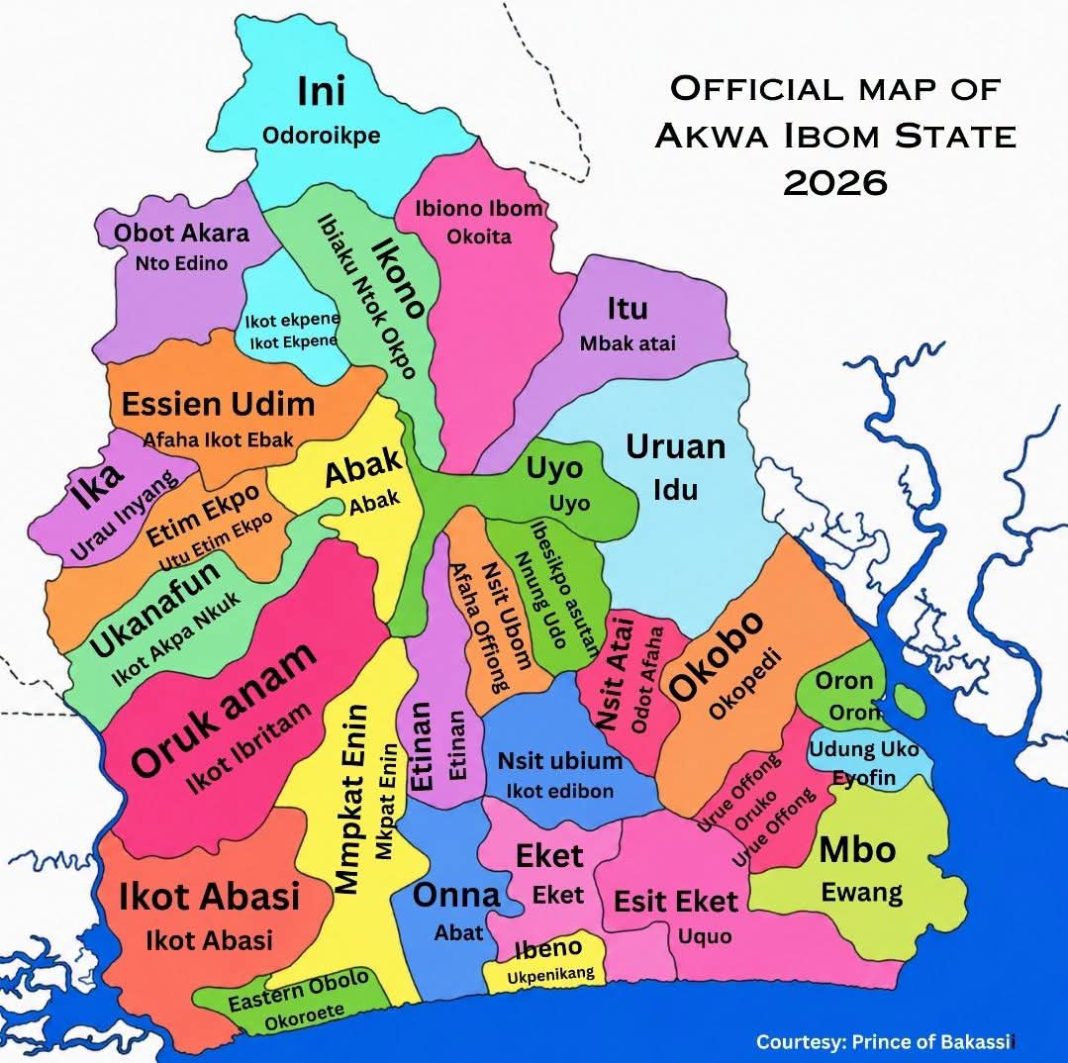
Etifit has been drumming of their “Atlantic shoreline”, and has also been claiming that certain 1913-2026 official maps have been showing them as littoral.
Though he failed to produce such maps, the heat is claimed are currently generating has its roots in 2021 when the Oro leaders started to frustrate the controversial Ibom Deep Seaport project.
As President General of the Oron Union, Bishop Etim Ante, in a petition dated May 12, 2021 scared away the principal investors of the deep seaport project, Bollore Transport Logistics of France.
Since then, concerned Ibibio people have been firing at the Oro people from all fronts for allegedly frustrating the multi-billion dollar seaport project that has been promoted as the economic game changer in the largely civil service state.
Now, Ekpe, who is a very vocal lawyer and activist is seriously challenging the Oro claim of being a littoral society. He is daring the ethnic group for a debate with facts, law, maps, and not with sentiments.
According to the rights lawyer, “littoral status is not emotional. It is legal, technical, hydrological, and geographical. Under international law, particularly the United Nations Convention on the Law of the Sea, UNCLOS, and under Nigerian municipal law, the term ‘littoral’ or ‘coastal’ refers to communities that sit directly on the seashore or ocean frontage.”
Continuing, he said, “in Nigerian law, this is now codified for petroleum purposes: Section 235(3) of the Petroleum Industry Act, 2021, provides that for deepwater areas, a ‘littoral community’ means a community located along the Gulf of Guinea coastline up to about 500 metres inland.
“A littoral status is not conferred by the number of rivers, tributaries, lakes, or internal waterways a community has. It is determined by direct contact with the ocean/ coastline.
“We do not classify riverine states as littoral. Abia State has the Imo River passing through it, yet it is classified as a landlocked state. Kogi, Anambra, and Ebonyi States sit on the banks of the River Niger, but are not classified as littoral. Benue State sits on the River Benue, but is not littoral.
“Internationally, having major rivers does not make a country coastal. Uganda sits on Lake Victoria and the River Nile, yet it is classified as landlocked. Mali is traversed by the River Niger, yet it is landlocked. Zimbabwe is drained by the Zambezi and Limpopo Rivers, yet it is landlocked.
“Burkina Faso has the Mouhoun, Nazinon and Nakambe Rivers, yet it is landlocked. Ethiopia is crossed by the Blue Nile, Awash and Omo Rivers, yet it is landlocked.”
In Akwa Ibom, Ekpe said Itu and Uruan Local Government Areas sit on the same Cross River shoreline as Oro people, yet they do not claim littoral status and are not classified as such.
Ukanafun, Nsit Ubium, Nsit Ibom, Oruk Anam, etc., all sit on the banks of the Qua Iboe River, yet they are not described as littoral.”
Clear Judicial Precedent
The activist disclosed that in the 2012 Supreme Court judgment between Cross River State and Akwa Ibom, the apex court held that following the 2002 ICJ judgment ceding the Bakassi Peninsula to Cameroon, Cross River no longer had a seaward coastline contiguous to the open ocean, and therefore could not claim littoral/offshore entitlement.
He then argues that if Cross River, which is geographically closer to the Atlantic, was held not to be littoral after 2012, how then can Oro, which lies further inland along the Cross River shoreline, claim littoral status?
The Oro ethnic nationality, according to him, lies on the western bank of the Cross River, directly opposite Cross River State on the eastern bank. Yet, Oro leaders have been claiming that their ethnic group, covering five local government areas, is littoral.
By their logic, Ekpe is asking whether Urue Offong/Oruko Local Government Ares, which is completely landlocked with no access to the Cross River shoreline, would also be littoral?
“Littoral status is not conferred by noise, social media campaigns, or ethnic pressure. It is conferred by law, geography”, says the activist.
For him, coastal and littoral communities in Akwa Ibom are Esit Eket, Eket, Ibeno, Onna, Mkpat Enin, Eastern Obolo and Ikot Abasi Local Government Areas.
Still disputing the Oro claim, he said one of the earliest maps of the Oro people is the Official Map of Eket District dated 1913 and enacted by Dr. Percy A. Talbot, the colonial district officer for Eket during the time Oro was under Eket Administration.
“In the map, the Oro people which today have been divided into Oron, Okobo, Udung Uko, Mbo and Urue Offong Oruko LGAs, have no access to the Atlantic coastline.
“In the same map, Ekid territory presently divided into Eket and Esit Eket LGAs is shown occupying the entire Atlantic coastline east of Qua Iboe River. In contrast, Ibeno settlement was shown as comprising five refugee settlements on either side of Qua Iboe River on the land granted to them by Ibibio ancestors.”
Not yet done, he said in the 1916 lawsuit between Mkpanak Ibeno and Ekid, this map was tendered and guided by the British presiding judge, Mr. Justice A.F.C. Weber in his decision, and who declared that “the evidence shows that Eket the Southern Ibibios are in exclusive possession of the land in dispute”.
The court went ahead to declare that from the mouth of Qua Iboe River to Child’s Point is the land of the southern Ibibios of Eket. Today, Child’s Point is where Okposo II village is located.
Adding, Ekpe said, “the interesting thing is that Oro ancestors testified in that case as witnesses. So did their ancestors not know at the time that they owned the land but not Ibibio?
“Unlike the Oro sweeping claims based on non-existent maps, we declare that the said 1913 map can be obtained from the British colonial archives at Kew, Richmond in London.”
But, Apostle Etifit is claiming that Oro has 60 kilometres of the Atlantic coastline. On this, Ekpe says this weird claim is rather that of ignorance than deliberate falsehood, adding, “this is because against the claim, Ibaka is not on the Atlantic coastline but along the estaury of the Cross River.
“From the mouth of the Cross River where that river meets with the Atlantic Ocean to Ibaka Bay, is less than one Kilometer thus, geographically, making Ibaka Bay part of the Cross River Estuary. Where then did Etifit manufacture 60 KMs from assuming ‘river shoreline’ was the same thing as ‘littoral coastline’?”
On UNCLOS, he said it is simply an international law statute that was enacted in 1982. This United Nations Convention on the Law of the Sea, abbreviated as UNCLOS 1982, does not, according to the lawyer, recognize Oro or any other community in the world as littoral community, otherwise “we call on Etifit to refer the world to the provision of UNCLOS 1982 that lists Oro as littoral.”
“The UNCLOS 1982 only sets out international maritime law as governing laws of nations”, Ekpe adds, pointing out that it was under the UNCLOS 1982 that the World Court in 2001 declared that Bakassi Peninsula is Cameroon territory.
“By the effect of the World Court judgement, the Supreme Court of Nigeria held in 2012 that Cross River State is no longer a littoral state. Where Cross River is not littoral, how can Oro that shares the entire shoreline boundary with Cross River be littoral?”
Etifit is equally laying claim to an uncertain 1976 National Boundary Commission report to validate his claim.
Dismissing this claim as fraudulent and mischief, the lawyer said the National Boundary Commission, NBC, did not exist as at 1976. “NBC was created in 2004 by an Act of the National Assembly. So the 1976 National Boundary Commission report does not exist.
“It’s only one of those fake stories created by the likes of Robin Etifit who, for lack of academic and social title, chose to add ‘Apostle’ and ‘First African Pope’, to himself— title that only makes sense in evening palmy joint gatherings.”