
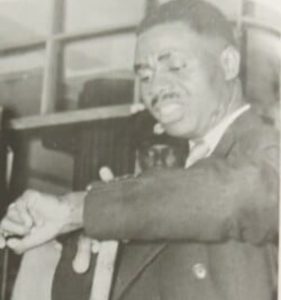
Parliamentarian, Political Activist, Statesman and Obong Ikpaisong Ibibio Ye Annang, Chief Effiong Okon Eyo, popularly known as Eyo Uyo, was one of the outstanding political figures produced by the old Eastern Region of Nigeria.
Born in 1918 in present day Ibesikpo Asutan Local Government Area, he became a teacher, businessman, politician, parliamentarian, administrator and traditional leader.
His political career spanned one of the most important periods in Nigerian history, the transition from colonial rule to self-government, independence and the subsequent restructuring of Nigeria into states.
Eyo’s name is particularly associated with the struggle of the minority peoples of the former Eastern Region for political representation, constitutional protection and the creation of separate states. He became one of the most persistent advocates of the Calabar-Ogoja-Rivers (COR) State Movement, a struggle which eventually evolved into the wider demand for the creation of what became Cross River and Akwa Ibom States.
Eyo attended Government College, Umuahia. After leaving the school, he worked at different times as a teacher, trader and clerk, experiences that brought him into close contact with ordinary people and the developing political and economic life of the Eastern Region.
Eyo entered politics at a time when Nigeria was moving towards representative government. In 1951, he successfully contested the election to represent Uyo in the Eastern Regional House of Assembly. Through the electoral arrangements of the period, he subsequently became a member of the Federal House of Representatives between 1953 and 1954.
His political rise was remarkable because the Eastern Region was then dominated politically by the NCNC and by the larger Igbo population. Eyo increasingly became a strong advocate for the political interests of the minority peoples of the region.
He served as Chief Whip in the Eastern House of Assembly and became an influential figure in regional politics.
The political crisis of the 1950s was a turning point in Eyo’s career.Eyo was initially associated with the National Council of Nigeria and the Cameroons (NCNC). His political relationship with Dr. Nnamdi Azikiwe later deteriorated, particularly over questions surrounding the affairs of the African Continental Bank (ACB) and the relationship between the bank and the Eastern Regional Government.The dispute became one of the major political controversies of the period. Eyo participated in efforts to have the affairs of the bank investigated, bringing him into direct conflict with the NCNC leadership.
Following the political fallout, Eyo moved into the opposition and became associated with the Action Group (AG). His new political position gave him greater room to pursue the issue that would define much of his later career, the political emancipation of the minority peoples of the Eastern Region and the creation of new states.
The struggle for state creation in the former Eastern Region was one of the most significant political movements in Nigeria’s pre-independence history.In 1953, the demand for separate states for minority communities became more prominent. Eyo Uyo was one of the political figures who pressed the colonial authorities to consider the creation of states for the minorities of the Eastern Region. The demand subsequently developed into the Calabar, Ogoja and Rivers (COR) State Movement, which was formally organized in December 1953.
The movement brought together political leaders from the non-Igbo provinces of Calabar, Ogoja and Rivers who believed that the minorities of the Eastern Region needed greater political autonomy and protection.The COR movement became a major vehicle through which the political fears and aspirations of the minorities were presented to the colonial government and constitutional authorities.
Among the prominent leaders associated with the wider movement were Dr. E.U. Udoma, Barrister O.O. Ita, Chief Andrew Bassey, Dr. Okoi Arikpo and Chief I.I. Murphy, while Eyo became one of its most prominent political advocates.
The COR State demand gained national and international attention during the constitutional conferences of the 1950s.At the 1957 Constitutional Conference in London, the question of minority fears and demands for separate states became a major issue. This eventually led to the appointment of the Minorities Commission, chaired by Sir Henry Willink, to investigate the concerns of minority communities in Nigeria.The struggle continued into the 1958 Constitutional Conference.
At that conference, Chief E.O. Eyo reiterated the demand for the creation of the COR State. His participation demonstrated that the demand for political restructuring was not a temporary political campaign but a sustained constitutional movement.Although the COR State was not created at independence, the campaign established an important precedent: that communities within Nigeria’s regions could legitimately demand political restructuring where they believed existing arrangements did not adequately protect their interests.
The pressure generated by the state creation movement also influenced administrative changes within the Eastern Region.
In 1959, the Eastern Regional Government created Uyo and Annang Provinces out of Calabar Province, while Ogoja Province was also reorganized. These changes did not satisfy the larger demand for separate states, but they represented recognition of some of the administrative and political concerns being raised by minority communities.
For Eyo and his contemporaries, however, the ultimate objective remained the creation of states that would give the people greater political control over their own affairs.
Eyo’s contribution went beyond agitation.As a parliamentarian, he participated directly in the legislative affairs of the Eastern Region and Nigeria.
He served as Deputy Speaker of the Eastern Region House of Assembly and held other important political responsibilities.
He was also associated with the administration and development institutions of the Eastern Region. His political career therefore combined legislative work, executive responsibilities and political advocacy.
The state creation campaign did not end with independence.
Following the political crisis and military takeover of 1966, the Federal Military Government began considering proposals for restructuring Nigeria.In September 1966, a committee on constitutional proposals sat in Lagos. According to historical accounts, Chief E.O. Eyo was mandated by the people of the former Uyo, Annang and Calabar Provinces to represent their interests before the committee.
Memoranda were submitted calling for the creation of a separate state for the people of the old Calabar Province and the non-Igbo areas of Ogoja.The political crisis and violence that followed in Nigeria prevented the committee’s work from producing the desired immediate result.
In 1967, the military government created twelve states, including the South-Eastern State out of the former Eastern Region.
The creation of the South-Eastern State represented an important stage in the long struggle for political restructuring, although it did not produce the separate Akwa Ibom State that many Ibom people had sought.
Eyo subsequently served as a Commissioner in the South-Eastern State administration under Governor U.J. Esuene.
His participation in the new state administration demonstrated his continuing relevance to the political affairs of the area even after the end of the old regional system.
The political campaign that Eyo and other minority leaders had begun in the 1950s did not end with the creation of the South-Eastern State.After the creation of the South-Eastern State, the people of the mainland area of the state continued to demand a state of their own.
In 1977, the Constituent Assembly was inaugurated, providing another opportunity for the people of the area to present their case for state creation.
On 25 February 1978, traditional rulers from the ten local government areas that now constitute Akwa Ibom State met at Etinan under the Traditional Rulers Conference. They adopted a resolution demanding the creation of Akwa Ibom State and forwarded the demand to the Constituent Assembly sitting in Lagos.This was a continuation of the political struggle that Eyo had helped to establish more than two decades earlier.
Although the Second Republic government under President Shehu Shagari did not create the requested state, the agitation continued.
The long struggle finally achieved success on 23 September 1987, when the military government of General Ibrahim Babangida created Akwa Ibom State, making it Nigeria’s 21st state at the time.
Thus, although E.O. Eyo did not live to see the creation of Akwa Ibom State as he died in 1983, his political career formed part of the historical foundation of the movement that eventually produced the state. Some records attribute the naming of the state to him.
Eyo’s importance was not restricted to partisan politics.
He was recognized as a major traditional and cultural leader and was conferred with the distinguished title of Obong Ikpaisong Ibibio Ye Annang by traditional rulers of the Ibibio and Annang peoples. The title made him one of the highest traditional title holders in the area that is now Akwa Ibom State.
He later became associated with the Great Nigeria People’s Party (GNPP) during the Second Republic and is said to have been the reason the GNPP won the Senate for Uyo Senatorial District through Senator George, incidentally, the father of the current Director General of the Akwa Ibom State Broadcasting Corporation, Mrs Imaobong Udoh.
Although he died in 1983, before the creation of Akwa Ibom State in 1987, the historical struggle with which he was associated continued beyond his lifetime and eventually achieved the objective of creating a state for the Ibom people.
For this reason, E.O. Eyo is remembered as a HERO, one of the early architects and persistent advocates of the political restructuring that eventually produced Akwa Ibom State.