
By Yusuf Kabiru
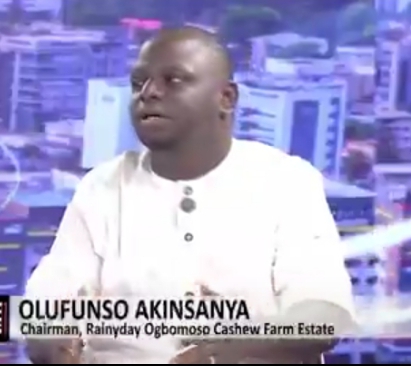
ABUJA — The Chairman of Rainyday Ogbomoso Cashew Farm Estate, Olufunso Akinsanya, has said that the promises made by President Bola Tinubu on agriculture are yet to translate into real impact for farmers on the ground.
Akinsanya spoke on ARISE News TV, where he gave a practical assessment of the state of agriculture in Nigeria, contrasting government announcements with the daily realities faced by farmers and agribusiness investors across the country.
According to him, there is a wide gap between policy pronouncements in Abuja and what farmers experience in their communities, particularly in rural areas where infrastructure remains poor and support systems are weak.
“There’s the theory of things and there’s the practicality. We have our plantation in Orire local government, after all the investment announcements by federal government we are still having electricity and water supply issues. As president of Rainyday, we dug a borehole in Orire community because people had to walk up to an hour to get to the nearest portable water source,” Akinsanya said.
He explained that despite repeated assurances by the Federal Government on investment in agriculture, food security and rural development, basic amenities that should support farming are still lacking in many farming communities.
Akinsanya noted that electricity and water, two critical inputs for modern agriculture, remain unreliable in Orire Local Government Area of Oyo State, where his cashew plantation is located. He said the situation has forced private investors to provide basic infrastructure that government should ordinarily have made available.
He disclosed that as President of Rainyday, he had to personally intervene by digging a borehole in the Orire community, after discovering that residents, including farmers and their families, had to walk up to an hour to get to the nearest source of portable water.
The intervention, he said, was not just a corporate social responsibility gesture, but a necessity, because without water, neither the community nor the farm could function effectively.
Akinsanya’s remarks come at a time when the Federal Government has continued to announce major reforms and investments aimed at boosting agricultural production, reducing food inflation and achieving food self-sufficiency.
President Tinubu had on several occasions declared a state of emergency on food security, promised increased support for farmers through inputs, mechanisation, credit facilities and improved rural infrastructure, and assured Nigerians that agriculture would become a major driver of economic growth and job creation.
However, Akinsanya argued that those promises are yet to be felt by farmers who continue to struggle with high cost of inputs, poor roads, lack of storage facilities, insecurity and absence of electricity and water in farming communities.
He called on the Federal Government to move beyond announcements and ensure that agricultural policies are implemented at the grassroots, where farmers can see and benefit from them.
He also urged government at all levels to prioritise rural infrastructure, noting that without electricity, water, roads and access to markets, Nigeria’s dream of agricultural transformation and food security would remain a mirage.
According to him, if private investors are left to provide basic amenities for host communities, the cost of doing agribusiness will remain high, discouraging investment and keeping food prices high for ordinary Nigerians.