
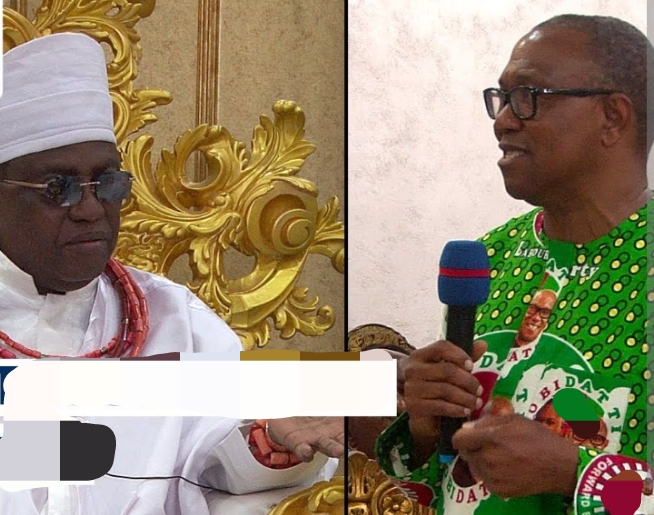
“Your Excellency, somebody showed me a letter where land was given to you in your state and you politely returned it and said that you didn’t need it, that you were there to serve…” – Oba of Benin
By Ronke Akase
Ahead of next year’s presidential election, Nigerians have recirculated viral video of the conversation between The Oba of Benin, His Royal Majesty, Omo N’Oba N’Edo Uku Akpolokpolo, Ewuare II, and former governor of Anambra State, Mr Peter Obi.
In the video captured prior to the 2023 presidential election, the Benin Monarch recalled a story of how Peter Obi, Labour Party presidential candidate (as he then was) reportedly rejected a parcel of land allocated to him while he was in office.
The revered monarch had raised the issue during a courtesy visit by Obi to the Benin palace, where he engaged the former governor in a brief but revealing exchange that has since attracted wide attention on social media.
“Your Excellency, somebody showed me a letter where land was given to you in your state and you politely returned it and said that you didn’t need it, that you were there to serve,” the Oba said.
“I saw the letter on social media and also read it physically, although it was an electronic copy. Is that correct?” the monarch asked.
Responding, Obi confirmed the story without hesitation.
“Your Majesty, very correct,” Obi replied.
“If anybody sees a piece of land allotted to me, my wife or any of my family members while I was governor, I will stop campaigning,” he added.
The exchange, which was captured on video and shared widely online, has reignited conversations about integrity, selflessness and accountability in public office in Nigeria.
For many Nigerians who watched the clip, the Oba’s question was significant not just because of what was asked, but because of who was asking. The Oba of Benin is one of the most respected traditional rulers in the country, and his public acknowledgement of Obi’s conduct has been interpreted by supporters as a strong moral endorsement.
The issue of land allocation to governors, their families, cronies and political associates has remained a controversial subject in Nigerian politics. In many states, outgoing governors and top officials are often accused of allocating choice government lands, houses and other public assets to themselves and their relatives.
Obi, who served as Governor of Anambra State from 2006 to 2014, has consistently maintained that he did not allocate any government land or property to himself, his wife, or any member of his family while in office.
He has repeatedly challenged anyone with evidence to the contrary to come forward, insisting that he was in government to serve and not to enrich himself.
Supporters of the former governor say the Benin palace exchange is further proof of his character and discipline in public office.
They describe Obi as being among the rarest breed of humans, arguing that he has conquered greed and that his lifestyle reflects prudence and contentment.
“Obi is among the rarest breed of humans. That man has conquered greed,” one supporter said.
“With him, we will not be wasting money on the offices of the First Son and First Daughter of the President. Nigeria needs him for a reset,” the supporter added.
The comment reflects a growing sentiment among Obi’s supporters, popularly known as the Obidient Movement, that Nigeria needs a leader who will cut down on the cost of governance, block leakages and prioritize the welfare of ordinary citizens over the comfort of political office holders.
Critics, however, say character alone is not enough to govern a complex country like Nigeria, and that Obi would still need to demonstrate capacity to manage the economy, security and national unity if given the opportunity.
Meanwhile, the Oba of Benin’s question and Obi’s confident response continue to generate debate across the country, with many Nigerians asking whether such a standard of public service can become the norm rather than the exception.