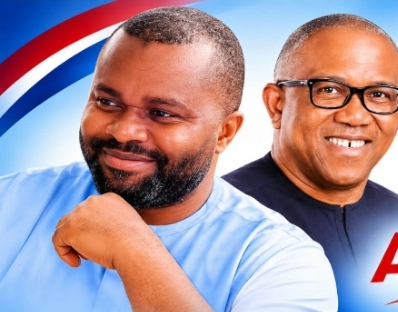
…says Peter Obi represents the desired change

Engr. Ubong Clement Idemudo is the candidate of the Nigeria Democratic Congress (NDC) for the House of Representatives, Ikot Abasi/Mkpat Enin/Eastern Obolo Federal Constituency in 2027.
In this explosive interview With select media professionals, the International Oil and Gas expert speaks on governance in Akwa Ibom, natural resources, indigenous participation, state assets and the 2027 elections.
Enjoy the EXCERPTS as captured by our Political Editorial Crew:
You have in recent times spoken at different fora about poor governance in Akwa Ibom State and how it affects the economy. Could it be because of difference in political party, or out of personal animosity towards Governor Umo Eno?
It’s certainly not because of difference in political party. I think it’s more of an intervention by a patriotic indigene who wishes the state well. I make this intervention not out of personal animosity towards Governor Umo Eno, but out of genuine concern for the economic future, collective heritage and prosperity of Akwa Ibom State.
Governance is not a popularity contest. Neither is it a permanent entitlement to public applause. Leadership must be measured by its capacity to protect public assets, expand economic opportunities, create jobs, empower indigenous businesses and improve the living conditions of ordinary citizens.
So, currently Sir, what is the fundamental question confronting Akwa Ibom people today?
The fundamental question confronting Akwa Ibom people today is simple: After the enormous financial resources that have accrued to this administration, what tangible economic transformation can the people point to as evidence of effective governance?
Okay. Let’s start with natural resources. What are your concerns about Ikot Abasi, Mkpat Enin and Eastern Obolo?
One of my greatest concerns is the future of the economic heritage of Ikot Abasi, Mkpat Enin and Eastern Obolo.
Our constituency is blessed with enormous maritime, petroleum, fishing and commercial opportunities. Yet, questions surrounding access to waterways, ownership of waterfront properties, land allocations and the participation of indigenous communities in major economic investments remain matters of serious public concern.
The reported controversies surrounding the Ukpum Ete waterfront and seaport development, including competing ownership claims involving Ikot Abasi and Eastern Obolo communities, demonstrate the urgency of transparent land administration and conflict resolution.
Why should our communities have to struggle to establish their legitimate interests in economic assets situated within their ancestral territories?
Why should indigenous entrepreneurs and investors not receive transparent, fair and equal opportunities to acquire legitimate land titles, including Certificates of Occupancy, where they satisfy the applicable legal requirements?
I insist that the government must publish relevant land allocation records, clarify the ownership and concession arrangements surrounding strategic waterfront properties and ensure that customary land rights are respected in accordance with the law.
Our natural endowments must not become instruments of economic exclusion. The wealth beneath our soil and the opportunities along our waterways must translate into prosperity for our people.
What’s your take on indigenous participation in oil and gas?
Akwa Ibom is one of Nigeria’s strategic oil-producing states. It is therefore reasonable to expect a government with a clear economic vision to develop indigenous participation in the petroleum industry.
Can the government not bring together credible Akwa Ibom entrepreneurs, engineers, financial institutions and indigenous investors to develop a structured investment platform for participating in petroleum licensing opportunities, marginal fields, oilfield services, gas development and other segments of the energy value chain?
This is not an impossible ambition.
The administration of Obong Victor Attah demonstrated that government could establish strategic economic institutions and create platforms for indigenous participation.
Universal Energy Resources Limited became associated with the development of the Stubb Creek marginal field. The company subsequently went through changes in ownership, and Savannah Energy’s 2024 technical report confirms that it owns Universal Energy Resources Limited and holds a 51% operated interest in Stubb Creek.
This raises legitimate questions about the history of Akwa Ibom’s participation, the evolution of its interests and the present value of any remaining state investment.
The public deserves a transparent account of the state’s historical shareholding, any divestment transactions and the proceeds received.
Why should Akwa Ibom not have a deliberate policy of developing indigenous oil and gas investors capable of competing nationally and internationally? Our people should not remain spectators in an industry operating on the wealth of their geographical environment.
You have also raised issues about the economic legacies of the Attah administration… (Cuts in)
Yes. Obong Victor Attah understood something fundamental about development: government must build institutions and economic assets that can generate value long after the tenure of an individual governor.
His administration established important strategic projects, including Ibom Power Company and the hospitality infrastructure that became Ibom Hotel and Golf Resort.
These assets were intended to position Akwa Ibom as an economic and investment destination. Today, their management and commercial performance deserve serious public scrutiny.
Ibom Power Company requires particular attention. Its ownership structure, generation capacity, operational performance, financial position and contribution to the state economy should be made public.
The company’s official records indicate that it continues to have a management structure. Therefore, the relevant question is not simply whether it exists, but whether it is delivering the economic value for which it was established.
Similarly, the Ibom Hotel and Golf Resort has undergone a prolonged rehabilitation programme. The government has made provisions totalling approximately ₦26.91 billion in the 2025 and 2026 budgets for its refurbishment and associated works.
The public deserves answers: What is the actual amount spent so far? Who are the contractors executing the project? What is the independently verified percentage of completion? What is the expected reopening date? What economic returns will justify this substantial public investment?
These are legitimate questions, not acts of political hostility.
You also mentioned, Sir, what you referred to as a financial windfall. What figures are you referring to, and what results do you expect?
Perhaps the most compelling basis for assessing this administration is the financial resources available to it.
A Premium Times investigation published in 2026 reported that the Umo Eno administration received approximately ₦2.227 trillion between July 2023 and September 2025.
The investigation raised serious concerns about fiscal transparency, access to public financial information and the relationship between the state’s increased revenue and visible development outcomes. This is a matter that deserves the attention of every Akwa Ibom citizen.
We must ask: What percentage of the resources received has gone into productive infrastructure? How many sustainable jobs have been created? What measurable improvement has occurred in rural healthcare and education? How much support has reached small and medium-scale indigenous businesses? What is the state government’s return on investment in its commercial assets? How much of the state’s revenue has translated into increased economic productivity?
The government should publish comprehensive budget implementation reports and independently verifiable project performance records. A government cannot demand unconditional praise while citizens are denied the information necessary to evaluate its performance.
The State government talks so much about Ibom as its cardinal investment or what have you. What is your position on Ibom Air?
Ibom Air is one of Akwa Ibom’s most important investments in the modern Nigerian economy. Established in 2019, the airline has grown into a significant aviation brand.
Available industry and company reports indicate that by September 2026, its fleet had reached ten aircraft, comprising seven CRJ900s and three Airbus A220-300s. This is an important achievement that should be acknowledged.
However, the expansion of the fleet must go hand in hand with operational efficiency, schedule reliability, customer satisfaction and financial sustainability.
The relevant question is whether the airline’s management and expansion strategy are delivering the highest possible value to the state and its citizens. Government must publish meaningful performance indicators, including aircraft availability, on-time departures, cancellations, passenger growth and operating profitability.
Our concern should be to protect Ibom Air as a sustainable public investment rather than reduce its performance to political propaganda.
But in nutshell, Sir, what kind of government do you think Akwa Ibom needs?
The greatest tragedy that can befall an oil-producing state is to remain economically dependent while its natural resources generate enormous wealth. We need a government that understands the relationship between natural resources, indigenous enterprise, industrialisation, employment and sustainable prosperity.
We need an indigenous enterprise development policy that gives qualified Akwa Ibom investors access to strategic economic opportunities. We need a comprehensive maritime development programme for Ikot Abasi, Mkpat Enin and Eastern Obolo. We need an oil and gas investment participation framework for indigenous entrepreneurs. We need functional industrial and commercial clusters. We need modern fishing terminals, processing facilities and cold-chain infrastructure. We need agricultural value chains that move our farmers from subsistence production to commercial profitability. We need transparent management of state-owned commercial enterprises. We need a deliberate youth employment and technical skills development programme.
These are not extravagant demands. They are reasonable expectations from a government entrusted with the resources and future of its people.
On a final note, Sir, what is your message ahead of 2027
The 2027 election presents an opportunity for a serious conversation about the future of our state and our constituency.
For Ikot Abasi, Mkpat Enin and Eastern Obolo Federal Constituency, the choice of representation must go beyond party loyalty, political friendships, financial inducements and emotional attachments. We need a representative who understands engineering, industry, petroleum development, infrastructure, commerce and the practical challenges confronting our communities.
As the NDC candidate for the Federal House of Representatives, I believe that public service must be anchored on competence, accountability, economic inclusion and measurable results. My vision is to pursue purposeful legislative representation that will attract federal investments, advance our maritime and petroleum economic interests, strengthen indigenous businesses and give our young people meaningful opportunities.
I do not claim that one individual can solve every problem. But I believe that the right representative, working with the people, relevant institutions and other levels of government, can make a significant difference.
We must move away from politics that celebrates personalities while neglecting the economic interests of the people. We must stop confusing political loyalty with good governance. We must stop applauding promises when measurable results are what we need.
The question is no longer which political party an individual belongs to. The question is what that political leadership has delivered and what it intends to deliver.
Akwa Ibom belongs to all of us, not to any political party, administration or individual. Our collective heritage must be protected. Our economic opportunities must be expanded. Our public assets must be preserved. And our children must inherit a state with greater opportunities than the one we inherited.
Akwa Ibom people must join the national call for a meaningful change at the center. His Excellency, Mr Peter Obi represents that change. And, I want to thank the people of my constituency who have resolved to be part of historic change.
In 2027, let us demand accountability, evaluate the alternatives and make our votes count. A new political direction is possible. A new economic future is necessary. This is the general voice of the people and it is the voice of God.
It’s been quite interesting sharing thoughts with you, Sir. We’re grateful.
It’s my pleasure. Thank you very much.