
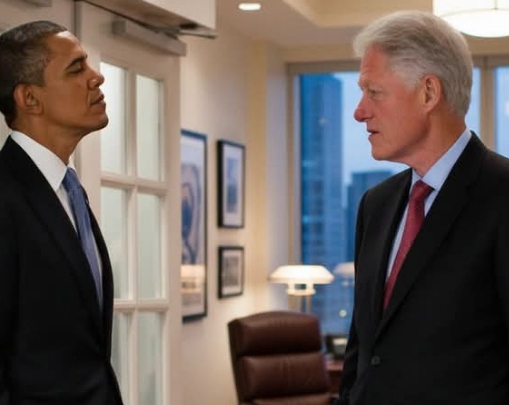
On the morning of November 5, 2008, at exactly 6:00 a.m., Barack Obama was sitting alone in a small room at the transition offices in Chicago when his phone rang.
The election was over, but the work had not yet begun.
He answered without ceremony.
“Congratulations,” said Bill Clinton.
The call was not brief.
It lasted more than an hour.
Clinton did not speak in slogans or memories.
He spoke in lists, cautions, and quiet warnings.
He began with the first hundred days.
Cabinet choices.
Who to bring close.
Who to keep at a distance.
Which offices would demand loyalty, and which would demand patience.
The country was sliding deeper into a financial crisis, and Clinton did not pretend otherwise.
“You will inherit panic,” he said.
“Do not let it rush you.”
He spoke about managing staff during chaos.
About how leaks always come from inside.
About how silence can sometimes calm a system faster than speed.
Then he spoke about children.
About Malia and Sasha.
About cameras.
About schools.
About the strange loneliness of growing up where every mistake becomes a headline.
“I raised Chelsea there,” Clinton said.
“Protect their ordinary days.”
What made the call unusual was not its warmth but its timing.
Only months earlier, Clinton’s wife had battled Obama in one of the most divisive primaries in modern politics.
The wounds were public.
The language had been sharp.
Yet Clinton set none of that on the table.
He spoke as a man who had already held the job.
And survived it.
Later, Obama would tell a close friend that one sentence stayed with him.
“The Oval Office is lonely,” Clinton warned.
“You will be surrounded by people every minute, yet you will still be alone, because the final decision is always yours.”
Clinton urged him to build a small inner circle.
Not admirers.
Truth tellers.
People willing to say no when everyone else said yes.
“I learned that late,” Clinton said.
“Learn it early.”
Their relationship did not end with that call.
It deepened.
It softened.
It became informal.
Obama called without scheduling.
Clinton answered without protocol.
They spoke about policy.
They spoke about fatigue.
They laughed about the absurd rituals of power.
Once, Clinton told him quietly that watching Obama take the oath of office had been one of the proudest moments of his life as an American.
Not as a former president.
As a citizen.
By the time Obama prepared to leave office in 2016, the relationship had become something else entirely.
He wrote Clinton a private letter.
Not for history.
Not for archives.
For the man.
“Thank you,” Obama wrote, “for being the big brother I never had in this job.”
There were no cameras for that letter.
No press release.
No applause.
Only two men who understood what power takes.
And what it gives back, rarely.
The story never became legend because it did not need to.
It became something better.
A quiet example.
That leadership is not only about winning.
That grace can follow rivalry.
That institutions survive when those who leave them care about those who enter next.
An elder once said, “Power is a house built for many owners, but it collapses when the last one burns it down.”
Clinton did not burn it.
Obama did not inherit ashes.
History remembers victories loudly.
But it keeps its deepest lessons in conversations held before sunrise.
© Copied