
Obong Sampson Udo Etuk belongs to that extraordinary generation of Akwa Ibom pioneers whose lives demonstrated that the destiny of a people could be transformed through education, organisation, sacrifice and visionary leadership.
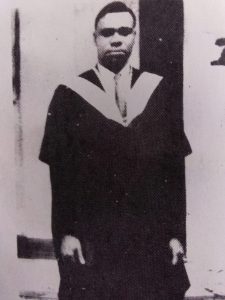
A community leader, educationist, nationalist and development crusader, Obong Sampson Udo Etuk occupies a special place in the history of Akwa Ibom because he was not merely a witness to the educational awakening of his people; he was one of its principal architects.
Born in Etinan, he obtained a Senior Teachers’ Certificate and a Senior Clerical Certificate and was appointed a Government Travelling Teacher in 1930.
His higher education included took him to the University of London/Institute of Education, London between 1938 and 1939. He later obtained an M.A. from Columbia University, USA.
As the first President-General of the Ibibio Union, he provided leadership at a defining moment when the people of the old Ibibio Division were beginning to appreciate the enormous power of education as an instrument for emancipation, social mobility and collective advancement.
The Ibibio Union itself emerged in 1928 as a pioneering organisation committed, among other objectives, to self-reliance, civic responsibility, moral advancement and the acquisition of higher education.
It was within this atmosphere of awakening that Etuk’s vision assumed historic importance.The story of the Ibibio Union’s famous overseas scholarship scheme cannot therefore be told without first telling the story of Sampson Udo Etuk.
In 1936, as President of the Ibibio Union, Etuk inaugurated what has been described by historians as the first major communal educational scholarship scheme of its kind in Nigeria.
The Ibibio Union Scholarship Fund began with only £20 in the bank. Etuk personally traversed the six Ibibio districts, mobilising support and persuading his people to contribute to an idea whose benefits would not necessarily be immediately visible but which, he understood, could alter the future of generations. Within one year, the fund had grown to £200.
One of the earliest beneficiaries of this communal commitment was E. A. Okon of Ibiono, a student at Government College, Umuahia, who received assistance from the fund when he could no longer maintain himself. His support helped demonstrate to a sceptical population that the scholarship idea was both practical and worthwhile. The confidence generated by that early success helped to expand the scheme dramatically.
By 1938, contributions to the scholarship fund had risen to more than £1,200. The Ibibio Union consequently took the historic decision to send six young men overseas for university education.That decision would become one of the most consequential acts of collective philanthropy and educational foresight in the history of the people who would later become citizens of Akwa Ibom State.
The beneficiaries, who became known as the “Merchants of Light,” were sent into the wider world to acquire knowledge and return home to illuminate the path for others.
Among them were Sir Egbert Udo Udoma, who studied Law; Bassey Udo Adiaha Attah, who studied Agriculture; Ibanga Udo Akpabio and James Lawson Nsima, who studied Education; Obot Essien Antia-Obong, who studied Medicine; and Asuquo Udo Idiong, who also studied Medicine in Canada. Idiong unfortunately died before completing his studies.
But the most remarkable part of Etuk’s story is that he was himself offered one of the scholarships.He declined.The reason was profoundly simple.As President of the Union and one of the principal figures behind the scholarship initiative, Etuk did not want anyone to believe that he had created a communal scholarship scheme merely to secure an overseas education for himself. He therefore chose to sponsor his own education rather than benefit from the fund he had helped establish.It was an extraordinary demonstration of public-spiritedness and personal integrity.
Historical accounts record that although Etuk declined the Union’s scholarship to study Law, he nevertheless travelled overseas with the scholarship beneficiaries as a self-sponsored student and leader.He understood leadership as service.He understood public resources as a trust.He understood that the credibility of an institution depends greatly on the integrity of those who lead it.
Etuk demonstrated a remarkable willingness to invest in the future of people other than himself.
His greatest legacy, therefore, was not the degree he might have obtained abroad through communal funding. It was the human capital he helped create.The six scholars sent abroad in 1938 went on to occupy significant positions in education, law, medicine, politics and public administration. Sir Egbert Udo Udoma became a distinguished jurist and later Chief Justice of Uganda and a Justice of the Supreme Court of Nigeria. Dr. Ibanga Udo Akpabio became an eminent educationist and political leader and played a major role in the development of higher education in Eastern Nigeria. Bassey Udo Adiaha Attah became a distinguished agricultural scientist and public servant, while the other beneficiaries similarly contributed to the development of their communities and country.
The educational revolution that followed was not accidental. It was the product of deliberate investment by men who understood that a people without access to knowledge would remain dependent on others to determine their destiny.Etuk belonged to that generation.
His leadership of the Ibibio Union also helped establish a broader philosophy of communal development. The Union was not conceived merely as a social organisation. It became a vehicle for educational advancement, social mobilisation, cultural consciousness and the articulation of the collective interests of the people.
Etuk’s generation understood that political emancipation could not be separated from intellectual emancipation.That conviction explains why education occupied such a central place in the Union’s activities.
The significance of Etuk’s contribution becomes even clearer when viewed against the historical circumstances of the time. Colonial Nigeria offered very limited opportunities for higher education to indigenous Africans. Government institutions were few, access was restricted, and many communities lacked the financial means to send their children to institutions outside the country.The Ibibio Union challenged that reality by creating its own pathway.Instead of waiting for government to provide opportunities, the people pooled their resources and created opportunities for themselves.Etuk provided the leadership that gave the idea direction and credibility.
His contribution also helped establish a tradition that would continue to shape the educational consciousness of the people of Akwa Ibom for generations.The schools, colleges, including the Ibibio State College he helped found in 1946, universities and professional institutions that later produced generations of Akwa Ibom professionals were built upon a foundation laid by pioneers such as Etuk and his contemporaries.
It is, therefore, fitting that his name continues to be associated with scholarship and intellectual excellence.The Obong Sampson Udo Etuk Memorial Lecture and Awards, instituted by Mboho Mkparawa Ibibio, continues to honour his memory by celebrating excellence and encouraging discussion on issues affecting Ibibio land, Akwa Ibom State and Nigeria.
He is the father of the famed 1991 SDP Governorship candidate, Arc. Ekong Etuk, and popular broadcaster, Eno Irukwu who was a former National Commissioner at the defunct National Electoral Commission, NECON, and grandfather of Pastor Agu Irukwu of Jesus House for All The Nations, London, who was the Guest Minister at the Akwa Ibom State Christmas Carol service in December, 2017, and one of the 8 church representatives that officiated at Queen Elizabeth’s funeral in September, 2022
For Akwa Ibom, Obong Sampson Udo Etuk represents the pioneering spirit of a people who refused to accept educational backwardness as their permanent condition.For Nigeria, he represents an early example of indigenous communal organisation being deployed to produce human capital.
As Akwa Ibom celebrates its 39th anniversary, the story of Obong Sampson Udo Etuk deserves a prominent place among the stories of the state’s foundational heroes.
Long before the creation of Akwa Ibom State in 1987, men like Etuk were already laying the intellectual foundations upon which the future state would be built.He belonged to the generation that understood that the future had to be prepared for before it arrived.
Obong Sampson Udo Etuk is celebrated today as a HERO because his legacy remains a reminder that the true measure of leadership is not what one receives from the people, but what one is willing to invest in their future.