
Long before Akwa Ibom State was created on September 23, 1987, Rt. Hon. Anthony Amba Wills-Obong had already established himself as one of the most persistent and influential voices in the struggle for the creation of a state for the people of the Mainland area of the former Cross River State.
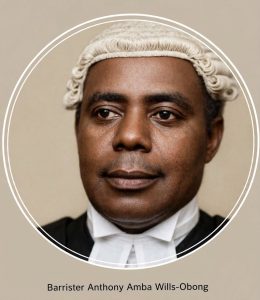
He was a lawyer, politician, legislator, constitutionalist, community leader and, above all, an indefatigable advocate for the political self-determination of his people.
Some reports say he coined the name Akwa Ibom State.
Born on June 12, 1930, Wills-Obong began his education at the Presbyterian Primary School, Mbiaya Uruan, where he graduated in 1942. He proceeded to the premier Ibibio State College, Ikot Ekpene, where he obtained his Cambridge Overseas Certificate in 1951.
His early professional career took him into the Ministry of Agriculture, where he worked from 1952 until 1966. But his ambitions and public responsibilities eventually moved beyond the civil service.He turned increasingly towards law and public affairs.
Wills-Obong enrolled at the University of Nigeria, Nsukka, to study Law, but the outbreak of the Nigerian Civil War disrupted his studies. Undeterred, he continued his legal education at Ahmadu Bello University, Zaria, where he completed his course between 1966 and 1970. The following year, he proceeded to the Nigeria Law School.His legal training would later become an important instrument in a much larger public mission.
By the late 1970s, the demand for the creation of a separate state for the people of the Mainland part of the former Cross River State had become a major political issue.
In 1977, Military Head of State General Olusegun Obasanjo constituted a Constituent Assembly. Wills-Obong emerged alongside Chief Donald Etiebet and Mr. N. J. Udoiwod as representatives from the area.
For Wills-Obong, the Constituent Assembly provided a national platform from which the aspirations of his people could be articulated.He did not approach the issue as a passing political demand. He saw state creation as an instrument for bringing government, development and political representation closer to the people.
In January 1978, Wills-Obong was mandated by members of the Constituent Assembly from Cross River State, coordinated by Chief Matthew Mbu, to submit a formal request for the creation of a Mainland State comprising the ten local government areas that constituted the proposed entity.
He took the request to the traditional rulers.That intervention produced one of the defining moments in the history of the state’s creation.
On February 25, 1978, a meeting of traditional rulers was held at Etinan, hosted by Obong J. D. Ekwerre. It was at that historic gathering that the name Akwa Ibom State was adopted for the proposed state, with Uyo designated as its headquarters.Ten Paramount Rulers endorsed the resolution, alongside Wills-Obong, Udoiwod and Chief Effiong Eyo, popularly known as Eyo Uyo.
The traditional rulers included Obong Sampson Udo Idiong of Ukanafun who chaired the conference, Obong Simon Tom Akpan Nsubong II of Etinan, Obong Thompson Udo Uyoata Akpabio of Eket who was vice chairman, Obong Ekpe-Obong Atakpa of Itu, Obong Pastor E.U.A. Arthur of Abak, Obong Cosmas O. Akpan of Ikot Ekpene, Obong Jacob Akpan of Ikono, Obong Aman Umoessien of Ikot Abasi, Obong Okon Eyokunyi Isong of Oron and Obong Ekpenyong Udoekong of Uyo.
The endorsement gave the state creation campaign an important traditional and institutional foundation.
Wills-Obong subsequently became the recognised spokesman for the Mainland State creation struggle.He founded the Mainland (Akwa Ibom) State Movement, with its office at No. 13A, later No. 11, Wellington Bassey Way, Uyo. Chief Horace Equere served as Vice Chairman, while Rev. S. J. King was Secretary.
The struggle, however, did not immediately succeed.The military government at the time considered that it had insufficient time to complete the process of creating new states. The proposal therefore suffered another setback.
But Wills-Obong and other leaders of the movement did not retreat.On July 21, 1980, he published a piece in the Nigerian Chronicle titled “Creation of States: Can We Sit on the Fence?”The article attracted strong criticism from powerful quarters, but it also demonstrated the character that would define his campaign.He was prepared to publicly confront opposition when he believed the interests of his people were at stake.
At a critical moment, he found an equally determined ally in Chief Effiong Eyo (Eyo Uyo) who himself was an arrowhead of the campaign. It is said that on his sick bed before his death, Eyo Uyo held Wills-Obong and officially handed over the struggle to him.
Wills-Obong subsequently attended meetings of the National Association for the Creation of States in Lagos, where he presented memoranda advocating the creation of Akwa Ibom State. He also presented the case to the then Senate President, Dr. Joseph Wayas.
When another opportunity emerged in 1986, he again mobilised traditional rulers and took the agitation to the Political Bureau.
Following the dissolution of the Political Bureau by the military government of General Ibrahim Babangida,Wills-Obong did not allow the process to die.
He took the memorandum for the creation of Akwa Ibom State to Major General Edet Akpan, who facilitated its submission to General Babangida.
The Supreme Council of Ibibio Traditional Rulers, Esop Mbong Ikpaisong Ibibio, had entrusted Wills-Obong with the authority to write, sign and submit the memorandum on the creation of the state to the Federal Military Government.
Years of advocacy finally produced the outcome for which he and generations of other leaders had campaigned.
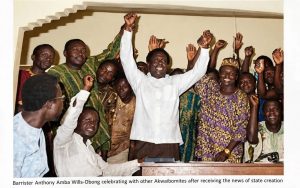
On September 23, 1987, President Ibrahim Babangida announced the creation of Akwa Ibom State, alongside Katsina State.
The dream had become reality.
For Wills-Obong, the achievement was more than a political victory. In words that captured his conviction after the announcement, he described the creation of Akwa Ibom as “not a pie in the sky, but the fulfillment of God’s plan for the welfare of millions of people in the mainland part of former Cross River State.”
But the state creation struggle was only one dimension of his public life.
Wills-Obong was also deeply involved in Nigeria’s constitutional development.In 1978, he became a member of the Constituent Assembly representing Ward 1, Uruan, in then Uyo Local Government Area.
He was also among the 49 members (otherwise called the 49 Wise men) who participated in the process that produced the 1979 Constitution. Chief Obafemi Awolowo who should have been the 50th member declined to serve on the Constitution Drafting Committee.
The Chairman of the Committee was Chief Frederick Rotimi Alade Williams, SAN, one of Nigeria’s most eminent constitutional lawyers. He was popularly known as F.R.A. Williams. Alhaji Gidado Idris served as the committee’s secretary.The Committee produced the draft constitution, which was subsequently submitted to a 230-member Constituent Assembly, chaired by Justice Udo Udoma, for consideration and final adjustments. The resulting Constitution came into force on 1 October 1979.
Between 1979 and 1983, he was a Member of the Cross River State House of Assembly, representing Northern and Central Uruan Constituency, where he also served as the Chief Whip of the House.
His public career therefore spanned the civil service, law, constitutional politics, legislative representation and the traditional institution.
He also held the traditional title of Eti of Uruan, reflecting the confidence his people placed in his leadership beyond the formal political structures of government.
His legacy has also found expression in the generation that came after him. His son, Hon. Frank Amba Wills-Obong, followed his father’s path of public service, serving as Councillor representing Northern Uruan Ward 2 and later as Majority Leader of the Uruan Local Government Legislature between 2012 and 2015.
That continuity is perhaps one of the clearest testimonies to the values Wills-Obong represented.
As Akwa Ibom marks its 39th anniversary, Barr. Anthony Amba Wills-Obong is remembered not just as a lawyer or politician, nor even merely as a participant in the state creation struggle but as one of its determined architects.
He gave the struggle a voice, a structure and a persistence that survived political setbacks until September 23, 1987, when the dream finally became a state.Akwa Ibom exists today as a political entity because many hands contributed to its creation. But among those whose names deserve a permanent place in the history of that journey is Rt.Hon. Anthony Amba Wills-Obong, the lawyer, legislator, constitutionalist and relentless spokesman who refused to let the dream of an Akwa Ibom State die.
He was, in every sense, a HERO of the Akwa Ibom project.