

…insists NNPC could not account for missing N20b
By Sanni Abdullahi
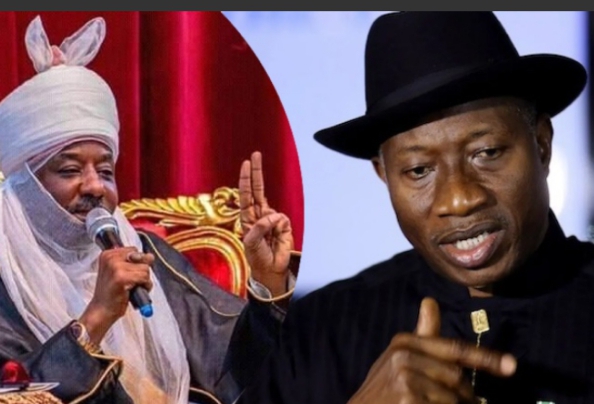
Former Governor of the Central Bank of Nigeria (CBN) and Emir of Kano, His Highness, Muhammadu Sanusi II, has revealed details of how former President Goodluck Jonathan accused the apex bank of leaking a letter he (Sanusi) wrote to the President on the missing funds in the Nigerian National Petroleum Corporation, NNPC.
In a recent televised interview, Sanusi disclosed that after former President Olusegun Obasanjo got the letter published, President Jonathan believed that it was the CBN that leaked it to the former President. He noted that though former governor of Rivers State, Rt. Honourable Rotimi Amaechi, recently said that he was the one who leaked the letter, the then President was convinced otherwise.
According to Sanusi, President Jonathan subsequently summoned him for a private meeting at the Presidential Villa, Aso Rock, where he issued a 24-hour ultimatum to him to either sack top officials of the CBN to prove his innocence or resign from office.
“The president said that he was convinced that it was the CBN that leaked the letter,” Sanusi stated.
He added that during the tense meeting, Jonathan told him to take decisive action against officials of the bank as a way of proving that the CBN was not responsible for the leak, or quit his position as CBN governor.
Sanusi made the revelation while revisiting the controversial audit that uncovered missing oil funds under the Jonathan administration, a development that eventually led to his suspension from office in 2014.
Recounting the sequence of events that led to the face-off with the Presidency, the former CBN chief said he had audited NNPC payments and discovered a huge shortfall in remittances to the Federation Account.
“I audited NNPC payments and found $49B missing. I wrote the President GEJ, but he didn’t respond. 4 months later, Obasanjo got the letter and gave the media. GEJ called a secret meeting, accounted for $29B but couldn’t explain $20 B. He then suspended me,” Sanusi said.
He explained that after discovering the missing $49 billion, he wrote a confidential letter to President Jonathan alerting him of the audit findings and seeking action, but received no response for months.
Four months later, the letter found its way to former President Olusegun Obasanjo, who subsequently made it public in his famous open letter to President Jonathan. The publication triggered a national and international uproar over alleged large-scale corruption in the oil sector.
Sanusi said it was after Obasanjo published the letter that Jonathan called him for the private meeting at the Villa. At the meeting, according to Sanusi, the Presidency was able to account for $29 billion out of the $49 billion, but could not explain the remaining $20 billion.
He said rather than addressing the substantive issue of the unaccounted funds, the administration turned its attention to the source of the leak, with the President insisting that the CBN must have been responsible.
The former CBN governor said the ultimatum to sack senior officials of the bank or resign was part of efforts to pressure him after he refused to back down on his findings.
Sanusi was eventually suspended from office by President Jonathan in February 2014, months after he raised the alarm over the missing funds. The Federal Government at the time cited financial recklessness and misconduct at the CBN as reasons for his suspension, an allegation Sanusi dismissed as politically motivated.
The revelation by Amaechi that he was the one who leaked the letter to Obasanjo has added a new twist to the decade-old controversy, which remains one of the most contentious episodes in Nigeria’s oil governance history.
Sanusi, who later became Emir of Kano and is currently a prominent voice on economic reforms, has consistently maintained that his audit was in the national interest and aimed at entrenching transparency and accountability in the management of oil revenues.