

His Royal Majesty, Obong Etim Charles Daniel Abia, FCA, is a distinguished Nigerian accountant, administrator, entrepreneur, public servant and traditional ruler whose remarkable life has traversed professional excellence, public administration, enterprise development and traditional leadership.
Born on November 11, 1936, Obong Abia has, over the course of nearly nine decades, distinguished himself in several fields of endeavour. His journey from the classrooms of Eket and Calabar to the corridors of government, the world of business and ultimately the traditional institution of the Ekid people reflects a life defined by intellectual curiosity, enterprise, public service and commitment to community.
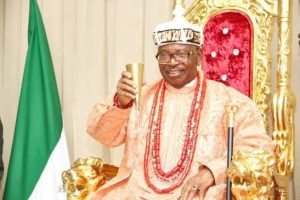
Today, he occupies the revered stool of the Paramount Ruler of Eket Local Government Area and bears the traditional title of Attah Ekid Afid, Attah I of Ekid Nation. He also serves as President of the Eket Traditional Rulers Council.
Young Etim Charles Daniel Abia received his early education in Eket before proceeding to St. Patrick’s College, Calabar, where he distinguished himself academically and obtained a Grade I Cambridge School Certificate.His intellectual interests were remarkably broad.
He began his working career as a Court Clerk in the Judiciary Department of the then Eastern Nigeria Government. Rather than remain within the confines of his first profession, however, he embarked on a journey of continuous learning.
He subsequently trained in Medical Technology at the University College Hospital, Ibadan, and also pursued studies in law, obtaining an intermediate qualification towards an LL.B. His search for wider knowledge eventually led him to the study of Economics and Accounting at the University of Dublin, where he graduated with Second Class Upper Honours.
In June 1965, he was inducted as a Chartered Accountant, earning the professional designation FCA. His unusual combination of training in administration, law, medical science, economics and accounting would later become an important foundation for his career in government and business.
Obong Abia’s public-service career acquired particular significance during the difficult period following the Nigerian Civil War.
He became part of the administrative team of the newly created South-Eastern State under the military administration of Brigadier-General U. J. Esuene and served first as the Accountant General of the new state, and subsequently as a (super) Permanent Secretary in the Ministry of Finance.
The period was one of reconstruction. Government had to restore economic activity, rebuild institutions and create an environment in which commerce and industry could recover after the devastation of the war.In that environment, Abia’s accounting and administrative expertise became particularly valuable. Historical accounts credit the administration in which he served with establishing institutions including the Mercantile Bank of Nigeria, Manilla Insurance Company and Investment Trust, alongside other state-owned enterprises designed to support economic and industrial development.His competence and experience eventually earned him appointment as Commissioner for Finance of the former South-Eastern State.
His contribution during this era remains an important part of his public-service legacy: he was not merely a participant in government but a technocrat operating at a time when sound financial administration and institution-building were essential to the recovery and development of the region.
Having established himself in public administration, Obong Abia later demonstrated that his entrepreneurial instincts were as strong as his administrative abilities.
He became one of the prominent indigenous businessmen associated with the industrial and commercial expansion of Eket and the wider region during the 1980s.
Among his best-known business achievements was securing the regional franchise for Dr. Pepper Bottling Company and establishing its plant in Eket. Contemporary accounts describe the venture as a commercial undertaking that brought a globally recognised beverage brand into the regional market.
His entrepreneurial interests, however, extended beyond beverage manufacturing. He was associated with enterprises including Grandi Lavori, an engineering concern, and Masibob, reflecting his interest in construction, engineering, agriculture and other productive sectors.
Through these ventures, Abia became identified with an era when indigenous entrepreneurs were beginning to play a more prominent role in the industrialisation and commercial development of the Niger Delta and South-Eastern Nigeria.
His business career also reinforced one of the enduring characteristics of his personality: the willingness to venture into unfamiliar territory, acquire new knowledge and translate ideas into practical enterprises.
Long before he ascended the paramount stool, Obong Abia had already established a strong relationship with the traditional institution of his people.He served as the Clan Head of Idua before eventually ascending to the highest traditional office in Eket Local Government Area.
He was crowned Paramount Ruler of Eket Local Government Area on November 25, 2016, at the Eket Sports Stadium, succeeding to a position that carries substantial responsibility for the cultural identity, unity and social cohesion of the Ekid people.
His traditional title, Attah Ekid Afid, reflects his position as the traditional head of the Ekid Nation.Interestingly, his association with the traditional institution predates his coronation by several decades. Historical accounts indicate that in 1987 he was persuaded by his community to accept the distinguished traditional title of Ata of Eket, a title also associated with prominent historical figures such as former military governor U. J. Esuene and former Central Bank Governor Dr. Clement Isong.
His eventual emergence as Paramount Ruler therefore represented not a sudden transition into traditional leadership, but the culmination of a long association with the cultural and traditional affairs of his people.
As a traditional ruler, Obong Abia has increasingly used his position to promote peace, dialogue, cultural identity and development within Eket and the broader Ekid Nation.His interventions in community affairs have often reflected his background as an administrator and negotiator: listening to different interests, engaging stakeholders and seeking peaceful approaches to difficult questions.He has also participated in wider conversations concerning the identity, heritage and interests of the Ekid people and the Ibibio nation. In one such engagement, he publicly affirmed the historical and cultural ties of Eket with the wider Ibibio family.
In his capacity as Paramount Ruler, he has continued to engage with government, businesses and development organisations on issues affecting the people of Eket.For example, during the commissioning of a community development project supported by companies operating in the area, he emphasised the importance of education and community development and called for continued investment in local infrastructure.He has also advocated for the revival of important development assets in Eket, including the historic Qua River Hotel, reflecting his longstanding interest in restoring the town’s position as an important economic and tourism centre.
Obong Abia’s reign has coincided with a period of rapid economic, social and infrastructural transformation in Akwa Ibom State.
His background gives him a distinctive perspective on development. Having worked inside government, managed financial responsibilities, built private enterprises and presided over a traditional institution, he represents a bridge between several generations of Nigerian leadership.
He belongs to a generation that witnessed colonial administration, independence, the Civil War, post-war reconstruction, military rule, the return to democratic government and the transformation of the Niger Delta economy.His life therefore mirrors, in many respects, the story of modern Nigeria itself.
The same individual who began his working life as a court clerk would go on to become a medical technologist trainee, a student of law, a university graduate in economics and accounting, a Chartered Accountant, a senior government official, Accountant General and super Permanent Secretary, industrialist and businessman, and eventually a revered traditional ruler.
It is this breadth of experience that has earned him descriptions such as a “fount of knowledge” in tributes celebrating his life and achievements.
His story is, therefore, that of a traditional ruler who once held public office. It is the story of a professional who carried his knowledge from one field to another and used each experience to prepare for the next chapter of his life.
Obong Abia is married to Her Majesty, Obonganwan Mandu C. Abia, daughter of the famed Ibibio State Union “Merchant of Light,” Lawrence Nsima. On returning to Nigeria after his studies abroad, Nsima became Vice Principal of Ibibio State College, Ikot Ekpene, under one of his colleagues, Ibanga Udo Akpabio as Principal.
His place in the history of Eket and the wider Akwa Ibom region is consequently defined not by one achievement, but by the cumulative impact of a long and extraordinarily varied life.
As Akwa Ibom State turns 39, PRIDE Obong E.C.D.Abia, FCA, is celebrated as one of those who built the then South Eastern State (now Akwa Ibom and Cross River States) after the Nigerian Civil War, and the expansion of indigenous enterprise in the area.