
Century HealthWise: Act fast before your situation turns worse
The patient’s story, a 29-year-old man full of life, started 2 weeks earlier with a fever that kept getting worse. At his first clinic, a Malaria Rapid Test (RDT) came back positive. So he was treated right away with Artemether/Lumefantrine (Coartem) and paracetamol.
But his fever did not go away. He went to two other clinics and was treated again as an outpatient with more fever medicine and more malaria drugs. At the third clinic, when he started getting diarrhea, he was just given oral Metronidazole with paracetamol and sent home.
This shows a common medical trend and mistake: Malaria RDTs can stay positive for weeks or even months after malaria has already been cured. That’s because of a protein called histidine-rich protein 2 (HRP2) that stays in the blood. If a patient still has fever after recent malaria treatment, it is risky to just trust another RDT that comes out positive. The right step is to do a Malaria Parasite Slide (MPS) blood test under a microscope. This shows if there are real live parasites or if the RDT positive is just as a result of leftover protein, This ensures that we completely rule it out and so we don’t get miss other possible causes of high Fever.
By week 3, things got much worse for the 29-year-old. The patient came to our hospital fully awake but in very obvious severe pain, with a high-grade fever of 40.
He had severe abdominal pain over his abdomen and gave a history of not having passed stool or gas for 3 full days right after an episode of diarrhea. On examination, his abdomen was hard and tense, slightly distended, and very tender that he wouldn’t allow me to easily touch it. His muscles tightened when I tried to touch him, and even a light touch made him cry out in pain.
A hard, painful Abdomen in week 3 of a fever that won’t go away pointed strongly to late-stage complicated Typhoid Fever.
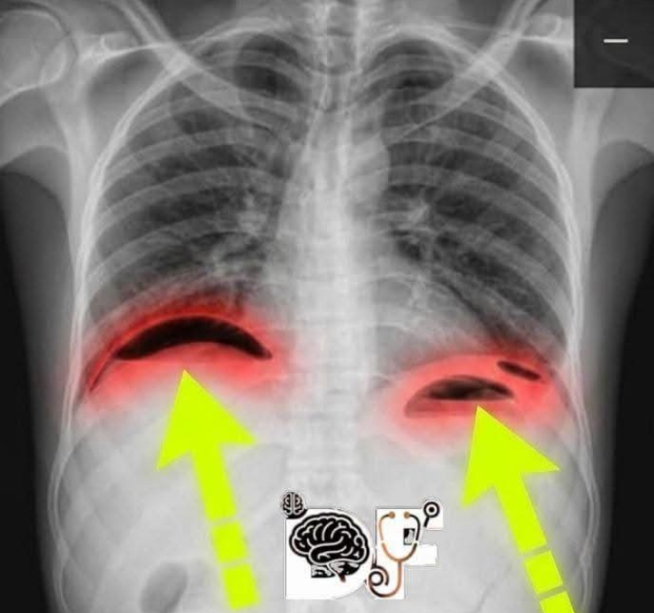
We quickly rushed the patient to the X-ray department and We did an urgent standing chest X-ray, which is the medical image attached. It showed clear signs. Because air in the abdomen rises to the top when you stand, the X-ray showed free air under the diaphragm. This is called pneumoperitoneum. Free air is usually easiest to see under the right side of the diaphragm as a clear air crescent between the liver and diaphragm. But we must also check the left side. On the left, we must tell the difference between free air and the normal air in the stomach or colon by looking for thin lines of air outlining both the top and bottom of the diaphragm or the bowel wall.
This was, in fact, an acute abdomen secondary to peritonitis complicated by typhoid fever due to bowel perforation, evidenced by pneumoperitoneum (air under the diaphragm).
Here’s why this happens at exactly week 3. Typhoid fever is caused by bacteria called Salmonella enterica serotype Typhi. The bacteria attack the gut lining and especially target immune tissue in the last part of the small intestine, called Peyer’s patches.In the first two weeks, when the patient kept being tossed around and being misdiagnosed and mismanaged with wrong medication Clinic after Clinic after Clinic, the bacteria took advantage and kept on multiplying heavily. This caused swelling, a buildup of immune cells, and poor blood flow to that area. By week 3 when he finally arrived at our facility, those damaged Peyer’s patches turn into ulcers on the outer side of the intestine. The ulcers eat through the full wall of the gut. This caused a hole in the bowel.Gas and gut contents then leak into his abdomen, leading to severe infection of the whole abdominal cavity called peritonitis seconded by an Acute Abdomen, A surgical Emergency !
The patient was immediately and aggressively given IV fluids, strong antibiotics, and a nasogastric tube through the nose not for feeding, but to release pressure in the stomach. He was rushed to theatre for an exploratory laparotomy surgery to open the abdomen, explore, and find where the problem was.
During surgery we found exactly what the textbooks describe: a clear, punched out hole in the terminal ileum, near where the small intestine joins the large intestine. After washing the abdomen thoroughly, repairing the hole, and giving intensive care after surgery, the early operation saved his life.
PEARL OF WISDOM!
To the frontliners…
Any fever that does not go away in primary care needs a careful, fair re-check. When a patient comes back with a high fever after 1 week of initial treatment, treat that visit as a serious warning sign, not just a normal follow up. Take time to check the previous prescriptions, remember the limits of tests like malaria RDTs staying positive long after treatment, and do a very detailed physical examination. Having early suspicion and changing your investigation plan before the bowel wall dies through and infection spreads in the whole abdomen is what turns this from a normal medical admission into an emergency surgery.
To the General Public…
A fever is like your body’s smoke alarm, it’s telling you there is a problem inside. If you finish your full treatment for malaria or another infection and the fever is still there after 1 week, do not just keep buying painkillers, changing pharmacies, or restarting the same tablets. When you go to a health facility, always carry your previous prescription cards and clearly tell the health worker: “I finished all my malaria medication last week, but the fever is still here.” That one piece of information tells the medical team to look deeper for conditions like Typhoid before serious complications happen. Seek urgent medical help right away if the fever continues and comes with severe abdominal pains , Diarrhea, vomiting, or if you have not passed stool or gas for even just 2 days…
©Doc Frank