
~HOW AKWA IBOM STATE GOVERNMENT FRUSTRATED ITS OWN GREATEST PROJECT- (PART ONE).
By Emem Benson, Esq.
For more than twenty-five years, Akwa Ibom State has carried in its hands the promise of the greatest maritime transformation in West and Central Africa. And for more than twenty-five years, successive governments of that same State have found one reason after another not to let it happen where nature, science, economics and God Himself placed it: Ibaka Bay, in Oron Nation.
This is not a story of lack of money. It is not a story of lack of expertise. It is not a story of lack of federal support. It is a story of insincerity, secrecy, manipulation, and a deliberate refusal to do what is right.
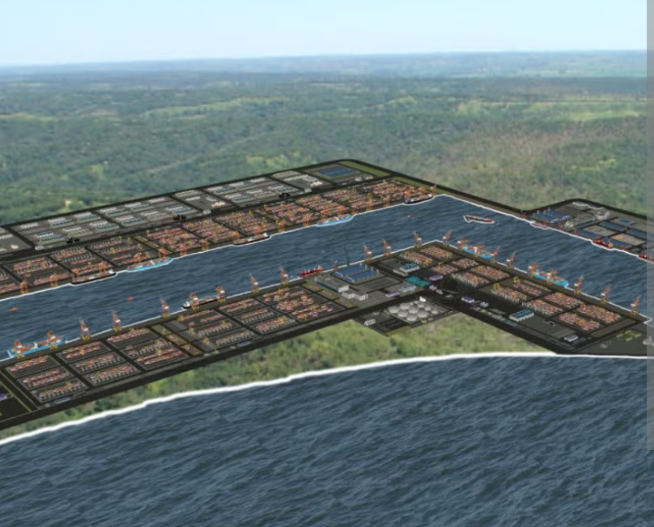
The Federal Government of Nigeria proposed the first Deep Seaport in Nigeria at Ibaka Bay to take advantage of a rare natural harbour. Scientific studies, including the 2015 peer-reviewed work by Ephraim U. Paul of Akwa Ibom State University and James M. Kahatu of Texas A&M University, established that Ibaka Bay possesses an average equilibrium, non-dredged draft of 13.5 metres, stable for many decades. Other assessments put it above 13 metres, and in recent public presentations, up to 19 metres. Such a harbour is rare in the world.
The original vision, conceived by former Governor Obong Victor Attah, was not just a port. It was an integrated maritime complex: a Deep Seaport at Ibaka Bay to serve as a transhipment port for the entire West and Central African sub-region, together with a Free Trade Zone, and a Mega Shipyard for the integration and maintenance of supertankers and Floating Production Storage and Offloading (FPSO) vessels.
A technical team that studied where Nigeria should locate a Mega Shipyard for FPSOs recommended only two locations in the whole country: Amasoma in Bayelsa State and Ibaka in Akwa Ibom State. Ibaka scored highest.
Imagine it: supertankers from Angola, Gabon, Equatorial Guinea, Cameroon and Nigeria coming to Ibaka for maintenance. Imagine thousands of direct and indirect jobs for the teeming unemployed youths of Akwa Ibom and Nigeria. Imagine the revenue, the industries, the transformation.
Financial modelling for the Deep Seaport at its natural location at Ibaka Bay put the cost at only about USD 2 billion, with only minimal maintenance dredging. It would have been one of the least expensive deep seaports of its kind in the world. That was the promise. That promise has been systematically betrayed.
THE APPROVALS THAT NEVER BECOME ACTUALISATION.
No project in Nigeria’s political history has been “approved” as many times as the Ibaka/Ibom Deep Seaport, and achieved as little on the ground. The cycle is now familiar, and shamefully predictable.
Under President Umaru Musa Yar’Adua / Goodluck Jonathan, the Federal Government incorporated the Ibaka Deep Seaport into its Port Development Initiative. In 2010, the then Governor Godswill Akpabio persuaded President Jonathan to adopt it. In 2011, Minister of Transport Idris Umar announced on national television that the Federal Government, in partnership with Akwa Ibom State, would build a Deep Seaport at Ibaka, with a Mega Shipyard and Free Trade Zone. In 2012, a Ministerial Steering Committee chaired by Engr. Iorwuese Viashima was inaugurated, and a Project Delivery Team was set up.
Under President Muhammadu Buhari, we heard of fresh approvals, fresh announcements, fresh committees. But nothing was on ground.
Under President Bola Tinubu, on Friday, 6th November 2026, during a visit to Uyo for his re-election campaign, the President was told on a campaign podium that Akwa Ibom has a natural harbour with a non-dredged draft of 19 metres, and he graciously gave “approval” again.
Was another presidential approval on a campaign podium really necessary? The people of Akwa Ibom know the answer. The project has become the most recycled campaign subject in Nigeria’s political election history, approved in every election cycle, abandoned after every election.
The President, an intelligent and strategic leader, was in my view misled. If he had been told that his predecessors had already approved the same project, and that nothing was on ground to show for it, he would not have been drawn into announcing yet another approval on a campaign podium. The reaction in the media space showed how counterproductive that announcement became.
Governor Umo Eno then attempted damage control: approvals, he said, are in stages. Later, on Channels Television, he said what the State seeks is actualisation, not approval. Both statements cannot stand together. If approvals are in stages, why seek another approval on a podium? If what is needed is actualization, why has actualization not happened in over a decade? This is the language of insincerity: say one thing on the podium, another on television, and do nothing on the ground.
THE GREAT ATTEMPTED RELOCATION: FROM A NATURAL HARBOUR TO AN ARTIFICIAL OCEAN
Of all the cardinal projects initiated by Obong Victor Attah, namely: the Science Park in Uyo, Akwa Ibom State University in Mkpat Enin, Ibom Power Plant in Ikot Abasi, Ibom Airport and MRO, Ibom Icon Hotel in Uruan, and Ibaka Deep Seaport and Ibom Industrial City in Mbo, it is only the Deep Seaport, the one located in Oron territory, that every successive administration has persistently sought to relocate elsewhere. The campaign continued even after Governor Akpabio performed the groundbreaking and laid the foundation stone for the Ibaka Deep Seaport and Ibom Industrial City at Ibaka, Mbo, on 28 May 2009. Why? Because Ibaka Bay is in Oron Nation, an ethnic minority in Akwa Ibom State. That is the uncomfortable truth the State Government has never honestly confronted.
Instead of building at the natural harbour, the State Government embraced an insane proposal: to dig a Deep Seaport out of dry land at Ibeno (Seaside). Its conceptual design, as analysed by experts, is staggering in its wastefulness:
▪︎ A basin 500 metres wide and 1.8 km long, dug out of dry land;
▪︎Two turning circles, with radii of 600 metres and 500 metres;
▪︎Two gigantic wave barriers with a combined length of over 2 km to protect the entrance from the Ibeno Surge;
▪︎Excavation of about 1.5 square kilometers, about 150 football fields, to a depth of about 18 metres;
▪︎About 50 million cubic metres of excavated material to be disposed of, at only God knows where.
When the question was asked: where will the 50 million cubic metres of the dug out materials go? The answer given was that it would be used to fill marshy areas of Mbo Local Government Area. Of course, this will be rightly rejected as unacceptable by the Oron people.
The cost? About USD 5 billion, clearly two and a half times the cost of the natural harbour option. And because dugout basins silt at triple the rate of natural harbours, maintenance dredging would be enormously expensive, forever. Can such a greenfield, high-cost port compete with other deep seaports coming up in Nigeria, especially the proposed Bakassi Deep Seaport, only about 30 km across the opposite side of Ibaka Bay in Cross River State? Basic logic says no. This is not development. This is the manufacture of a white elephant.
…TO BE CONTINUED AS PART TWO…
Emem Benson, Esq is a Legal Practitioner and Public Affairs Anayst.
17th November, 2026