

Kenneth Orji
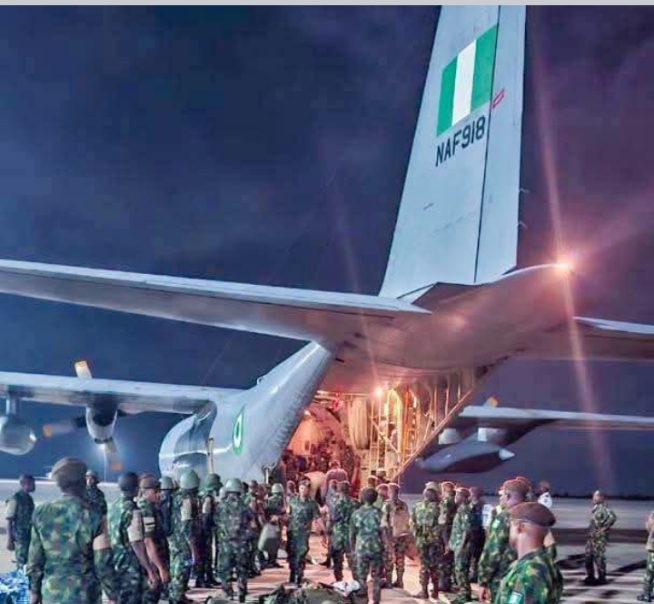
The Nigerian Air Force, NAF, has successfully airlifted 198 personnel of the Nigerian Company 11, NIGCOY 11 ECOMIG, to The Gambia aboard its C-130H aircraft, completing a strategic troop rotation under the ECOWAS Mission in The Gambia, ECOMIG.
The operation, conducted in two coordinated sorties between 26 and 30 May 2026, marked the seamless replacement of the outgoing Nigerian Company 10, NIGCOY 10 ECOMIG. In addition to the troops, the airlift facilitated the movement of operational equipment and personal effects required to sustain the contingent’s mandate on ground.
According to a statement released by the Nigerian Air Force Headquarters, the mission proves the Service’s capacity to project responsive and decisive air power beyond Nigeria’s borders. By deploying strategic airlift assets on short notice, the NAF enabled the rapid and efficient deployment of forces in support of peace, security and stability not only in The Gambia but across the wider ECOWAS sub-region.
According to Military aviation sources familiar with the operation, the two C-130H sorties were planned to minimize downtime for the mission and to ensure that the incoming contingent assumed duties without disruption to ECOMIG’s operational tempo. The C-130H, a long-range tactical airlifter in the NAF inventory, was configured to carry both personnel and essential mission cargo, reflecting the force’s multi-role air mobility capability.
The rotation is a routine but critical component of ECOWAS peace support architecture. NIGCOY forms part of Nigeria’s contribution to ECOMIG, the regional bloc’s mission established to support democratic governance, civilian protection, and stability in The Gambia following the 2016-2017 political crisis. Nigerian troops have been at the core of the mission since its inception, providing infantry, logistics, and engineering support alongside other West African contingents.
Analysts note that the successful execution of the airlift further demonstrates the Nigerian Air Force’s evolving role as a strategic enabler of multinational operations. Beyond combat air support, the NAF has increasingly positioned itself as a dependable air mobility partner for ECOWAS and other international coalitions operating in West Africa.
“Through sustained operational readiness, strategic airlift capability and mission-focused professionalism, the NAF continues to strengthen Nigeria’s leadership in regional security,” the Air Force stated.
The Service added that the operation reinforces Nigeria’s credibility as a committed contributor to international peace support efforts, particularly under the auspices of ECOWAS.
The Chief of the Air Staff has consistently emphasized the need for the NAF to maintain a high state of readiness to respond to both domestic and regional contingencies. The May rotation is the latest demonstration of that doctrine in practice, leveraging organic airlift to reduce dependence on commercial or foreign military transport for critical troop movements.
The Nigerian Air Force HQ said the mission also reflects Nigeria’s enduring commitment to advancing peace and stability across West Africa through ECOWAS mechanisms. The country remains the largest troop and financial contributor to several regional security initiatives, a posture Abuja says is necessary to prevent spillover of instability in a volatile sub-region.
Officials paid tribute to the professionalism, courage and sacrifice of the men and women of the Armed Forces of Nigeria who continue to serve in ECOMIG and other peacekeeping theaters. “Their unwavering service continues to promote collective security and regional cooperation,” the statement read.
With NIGCOY 11 now fully deployed, attention will shift to the operational activities of the new contingent as it takes over from its predecessor. ECOMIG’s mandate includes support to Gambian security institutions, protection of civilians, and contribution to a stable environment for democratic processes.
The successful airlift comes at a time when West Africa faces multiple security challenges, from insurgency to political transitions. Nigeria’s ability to rapidly move troops and equipment by air is therefore seen as a key enabler for ECOWAS’ collective response capacity.
Photo credit: Nigerian Air Force