
By Our Correspondent
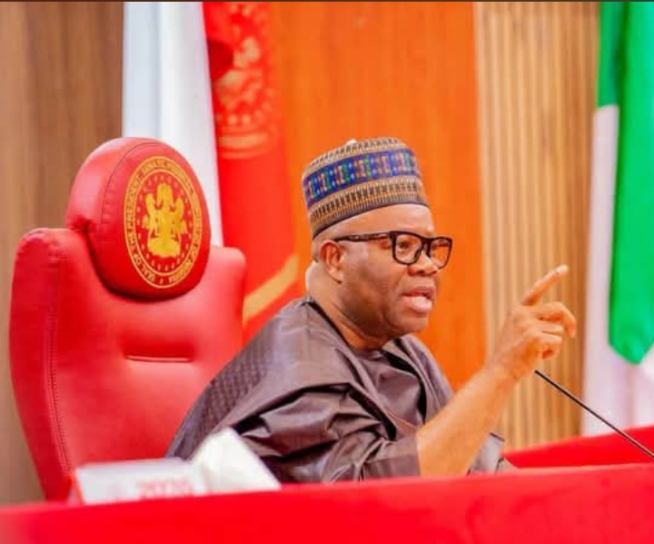
President of the Senate, Senator Godswill Akpabio, has formally petitioned the Department of State Services to investigate the origin and spread of a viral graphic that falsely attributed an inflammatory anti-North comment to him.
In a letter of petition dated Wednesday and signed by his Chief of Staff, Chinedu Akubueze Esq, Akpabio asked the DSS to urgently probe what he described as a “manifestly false, inflammatory and dangerously divisive statement” being circulated on Facebook and other digital platforms.
The controversy centers on a graphic bearing Akpabio’s photograph and official designation. The image quotes him as saying: “Northerners, You Will Be The Ones To Suffer The Most, If You Allow Tinubu To Lose The Election”.
According to the petition, the Senate President stated unequivocally that he did not make the statement.
“No date, venue, speech, interview, video, audio recordings, official statement or credible news report has been produced to authenticate it,” the petition read. “The graphic carries no identifiable publisher’s mark or verifiable source. It appears to have been deliberately manufactured and presented as an authentic quotation for the purpose of deceiving the public, provoking regional resentment against the President of the Senate and portraying him as threatening the people of Northern Nigeria.”
Akpabio, who serves as the Chairman of the National Assembly and presiding officer of the 10th Senate, argued that the fabrication was designed to damage his reputation and inflame regional tensions at a time of heightened political discourse in the country.
The petition flagged three individuals as among the earliest and most visible amplifiers of the content on Facebook. They were named as Abdullai Musa, who posted the graphic in a Facebook Group styled “Sheik Muhammad bin Uthman group 24”; Uzoma Chilaka, whose post reproduced the graphic alongside commentary expressly credited to Boniface Uzoma Chilaka; and Engineer Ibrahim Umar Ammar, a verified Facebook account that later reproduced the graphic with substantially similar commentary.
The Senate President’s office, however, cautioned against pre-judgment.
“These persons should not be presumed guilty before investigation,” the letter noted. “Nevertheless, their early and substantial roles in circulating the material makes them material persons of interest, who may possess information capable of identifying the graphics designer, original uploader, sponsors, intermediaries and the network through which it was distributed.”
Akpabio urged the DSS to examine the publication records, devices, communications, and the digital provenance of the image “in accordance with the laws” in order to uncover those responsible.
The petition comes amid growing concern over the weaponization of social media for disinformation, especially content that targets ethnic and regional fault lines. Security agencies have repeatedly warned that fabricated quotes attributed to public officials are often used to stoke division and undermine public trust.
References to President Bola Tinubu in the alleged fake quote place the incident within the broader context of pre-election political conversations, where statements are routinely twisted or invented to drive narratives online.
The DSS is yet to issue a public statement on the petition as of press time.
As learnt, if investigators establish that the graphic was deliberately forged and distributed to incite regional hatred, those found culpable could face charges under the Cybercrimes Act and other laws dealing with false information and incitement.
Akpabio’s office said it will cooperate fully with the security agency and provide any additional materials needed to aid the investigation. The Senate President also called on Nigerians to verify information before sharing it, warning that unchecked sharing of fake content poses a threat to national unity.
The development is yet another in a series of recent cases where top government officials have had to publicly debunk statements falsely attributed to them on social media.