
By Abigail Titus
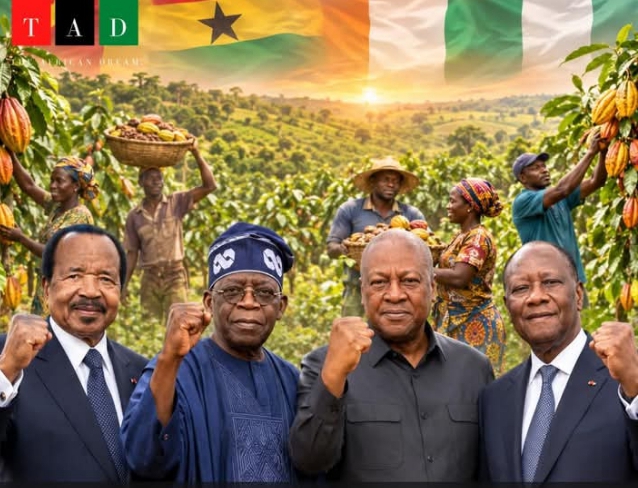
Nigeria, Ghana, Côte d’Ivoire and Cameroon, the four countries that produce about 70% of the world’s cocoa, have agreed to form a new regional bloc that will end decades of shipping raw cocoa beans to Europe and instead focus on processing at home.
The four governments are set to sign the Abuja Declaration at the Cocoa Value Addition Summit 2026 in Nigeria this year, formally establishing the Cocoa Value Addition Alliance. The pact commits the members to scale up local processing and begin exporting finished cocoa products like chocolate bars, cocoa powder, cocoa butter and cocoa liquor instead of bulk beans.
It is the first time the region’s top producers have moved together to break what officials described as a century-old trade pattern that has left Africa as a supplier of raw materials while Europe captures most of the value.
“For a hundred years, Africa has sent its cocoa to the world in sacks and received it back in wrappers,” Nigeria’s Minister of State for Industry, Senator John Owan Enoh, said ahead of the summit.
“That era is ending. The Cocoa Value Addition Alliance is about dignity, jobs and retaining wealth on our continent.”
A shift from raw exports to finished goods
Under the new alliance, Ghana, Cameroon, Nigeria and Côte d’Ivoire will coordinate investments in processing plants, harmonize standards, and create joint market access for “Made in Africa” cocoa products. The goal is to move up the value chain rather than compete to sell unprocessed beans at volatile commodity prices.
The timing is significant. Global demand for chocolate and cocoa ingredients continues to rise, but producer countries have long complained that they capture only a fraction of the final retail price.
Data shared at the summit shows the imbalance clearly. Despite producing more than 70% of global cocoa, Africa’s five largest cocoa-producing countries — Côte d’Ivoire, Ghana, Nigeria, Cameroon and Uganda — collectively earn only about $10 billion to $15 billion a year from cocoa exports.
By contrast, countries that do not grow cocoa at all dominate the downstream market. Germany, Belgium, Poland, Italy, Switzerland and the Netherlands together export around $28 billion worth of finished cocoa products annually, using beans largely imported from West and Central Africa.
“None of these countries grow a single cocoa pod, yet they earn almost double what the entire producing region makes,” a senior industry official at the summit noted. “The Abuja Declaration is designed to correct that.”
What the alliance aims to achieve
Organizers said the Cocoa Value Addition Alliance will focus on three priorities in its first five years:
– Industrial capacity: Attract investment for factories to process beans into butter, powder and chocolate within member states.
Policy alignment: Standardize quality, traceability and sustainability rules so African-processed cocoa can access premium markets in Europe, Asia and the Middle East.
Market development: Launch a joint brand and trade desk to negotiate better terms with buyers and retailers.
Experts stress that the move is not an export ban. Instead, it is a coordinated industrial policy to ensure a rising share of each harvest is processed locally before it leaves the continent. That, they argue, will create manufacturing jobs, stabilize farmer incomes, and reduce exposure to global bean price swings.
Breaking a colonial trade model
For decades, economists have described Africa’s cocoa trade as a textbook example of colonial-era economics: export raw commodities cheap, import finished goods dear. The alliance members say that model is no longer tenable given the size of their output and the skills available locally.
Senator Enoh said Nigeria will host pilot processing hubs and offer incentives to both local and foreign investors willing to set up plants. Ghana and Côte d’Ivoire, the world’s top two producers, are expected to commit existing state-owned processors to the alliance, while Cameroon will focus on specialty and organic cocoa products.
Uganda, the fifth of Africa’s top producers, was not listed as a signatory but attended the summit as an observer, with officials indicating it could join in a later phase.
Analysts say the success of the alliance will depend on access to energy, financing, and consistent quality. But the political signal is clear: the countries that grow the world’s cocoa now want to also make the world’s chocolate.
The Abuja Declaration is expected to be signed during the closing session of the Cocoa Value Addition Summit 2026, which brings together governments, farmers’ cooperatives, manufacturers and international buyers in Abuja.
If implemented, it would mark one of the most ambitious attempts yet by African commodity producers to rewrite the rules of global trade in their favor.