
…Dr. Alveda King joins advocates at Macpherson Garden, Urges U.S. Officials to act “quickly”
By Jack Roberts
WASHINGTON, D.C. — Just two blocks from the West Wing of the White House, a coalition of human rights advocates, faith leaders, and members of the Nigerian diaspora gathered this week at Macpherson Garden to deliver a stark message to U.S. government officials: the violence targeting Christian communities in Nigeria can no longer be treated as a distant crisis.
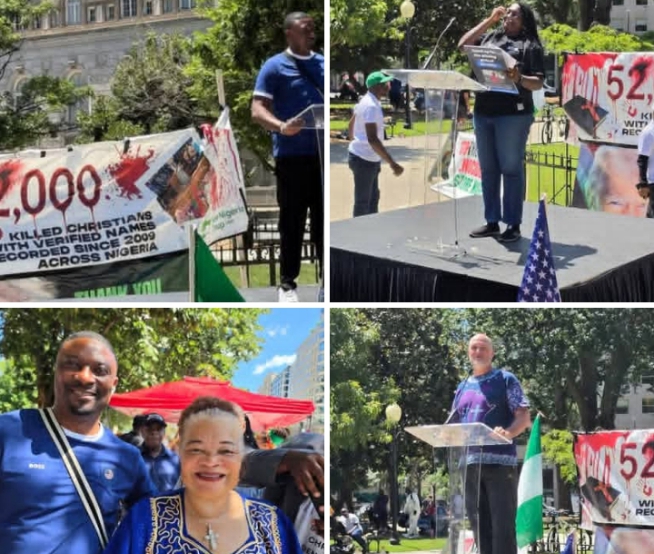
Under gray spring skies and within sight of the seat of American power, demonstrators held signs, shared testimonies, and called for immediate diplomatic and humanitarian intervention to address what they described as an ongoing genocide perpetrated by radical Islamist groups in parts of Nigeria.
The event, organized by EquippingThePersecuted with support from members of the legal and faith community, was framed not as a routine protest, but as a “moment of truth-telling and moral urgency,” according to organizers.
For the speakers and attendees, the location was intentional. Macpherson Square, a small park at 15th and H Streets NW, sits within walking distance of the White House, the State Department, and numerous congressional offices.
“Right in the heart of Washington, D.C.—just two blocks from the White House, the seat of the most powerful government in the world—we stood and made our voices impossible to ignore,” said Franc Fagah Utoo, Esq., a Knight of Columbus and representative of EquippingThePersecuted.
Before a crowd that included U.S. government officials, policymakers, members of the press, and members of the public, speakers detailed accounts of attacks on villages, churches, and farming communities across Nigeria’s Middle Belt and northern regions. They argued that the scale and pattern of the violence has been “often overlooked” in international reporting and policy discussions.
The group said their objective was simple and direct. “We simply called for a quicker action!” Utoo stated, urging the Biden administration and Congress to elevate the issue in bilateral talks with Abuja and to increase support for displaced families and faith-based humanitarian networks on the ground.
Organizers said they carried “the weight of the victims’ stories” to the nation’s capital, with the explicit aim of ensuring that those killed, displaced, or traumatized are “neither hidden nor forgotten.” Several participants said they had family or parish connections to affected areas and spoke of relatives who had fled burning villages or buried loved ones after midnight raids.
The rally drew national attention when Dr. Alveda King, niece of the late civil rights leader Dr. Martin Luther King Jr., addressed the gathering.
Standing at the same podium used by advocates, Dr. King delivered what attendees described as a powerful keynote that linked the American civil rights tradition to the current plight of persecuted Christians abroad. She recalled her uncle’s teaching that “injustice anywhere is a threat to justice everywhere,” and applied it to the situation in Nigeria.
“Silence in the face of injustice is never an option,” Dr. King told the crowd, according to organizers. Her remarks drew applause and, at times, tears from participants who said her presence gave moral weight to a cause they feel has been marginalized in Washington policy circles.
Dr. King’s participation also underscored a broader effort by organizers to build interfaith and cross-cultural solidarity. By invoking the legacy of nonviolent resistance and universal human dignity, speakers sought to position the Nigerian crisis within a larger American conversation about religious freedom and human rights.
While the gathering was largely symbolic, organizers outlined specific requests for U.S. policymakers. They called for more robust State Department reporting on religiously motivated violence, increased funding for protection and resettlement of internally displaced persons, and greater engagement with Nigerian civil society groups documenting abuses.
Several speakers urged the administration to press Nigerian authorities for accountability and for improved security in rural communities that they say remain vulnerable to armed groups. The term “genocide,” used repeatedly during the rally, reflects the advocates’ assessment that the attacks are systematic and targeted at Christian populations.
The protest comes amid ongoing debate in Washington about how to balance security cooperation with Nigeria against human rights concerns. Nigeria remains a key U.S. partner in counterterrorism efforts in West Africa, but faith-based organizations have argued that religious minorities require specific protections.
Many at Macpherson Garden were members of the Nigerian-American community who said they felt a personal responsibility to speak out. Some held photographs of destroyed churches. Others read names of towns that have appeared in recent incident reports from advocacy groups.
“This was not just another gathering,” one organizer said. “When you are two blocks from the White House, you are reminding power that it has a conscience.”
The event concluded with a prayer and a renewed pledge to continue lobbying on Capitol Hill. Participants said they plan follow-up meetings with congressional offices and will push for hearings that examine the scope of violence in Nigeria and the U.S. response.
As the crowd dispersed, the message from Macpherson Garden was clear: the distance between Washington and Nigeria’s conflict zones is geographic, not moral.
With Dr. King’s invocation of her uncle’s legacy still echoing, advocates said they will keep returning to the capital until their call for “quicker action” produces tangible policy change.
For EquippingThePersecuted and its allies, the rally was a starting point, not an endpoint. “We carried the responsibility to ensure that their suffering is neither hidden nor forgotten,” Utoo said, concluding: “And we will keep speaking until the world listens.”