
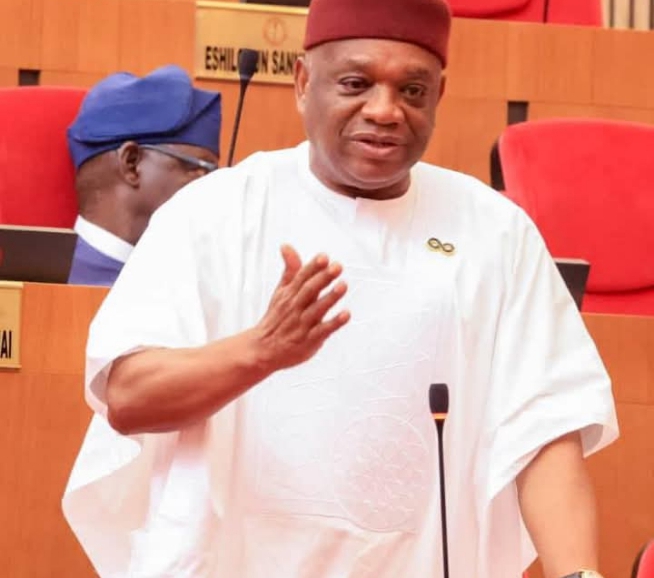
In the complex and ever-shifting landscape of Nigerian politics, the quest for effective leadership from the South East remains a central theme of national discourse. As the country looks toward future transitions, Professor Olu Aderounmu, the Pro-Chancellor of the Federal University Kashere, Gombe, has offered a compelling endorsement of Senator Orji Uzor Kalu. His message is not merely a gesture of collegiate goodwill; it is a strategic assessment of what is required to navigate the intricate path to the presidency.
The Definitive Political Heavyweight
Professor Aderounmu’s assertion begins with a clear premise: within the current political climate, Senator Orji Uzor Kalu stands out as an “unequivocal heavyweight.” This designation is not granted lightly. In the Nigerian context, a political heavyweight is defined by more than just tenure; it is a combination of executive experience, legislative influence, and grassroots mobilization.
Having served as the Executive Governor of Abia State and subsequently as a high-ranking member of the Nigerian Senate, Kalu possesses a dual-layered understanding of governance. His ability to maintain relevance across decades of political evolution in Nigeria speaks to a resilience that is rare. For the South East to present a formidable front in the national arena, Aderounmu argues that the region must rally behind figures who possess this level of established “political muscle.”
The Art of Coalition Building
Perhaps the most critical aspect of Professor Aderounmu’s message is his observation regarding the mechanics of power. He notes that, “unknown to many in the South East, politics requires that you must build coalitions across the geopolitical zones.”
This is a vital lesson in Nigerian statecraft. The presidency is never a regional gift; it is the result of a complex mathematical equation involving the six geopolitical zones. A candidate cannot rely solely on the fervor of their home base. To win, a leader must be able to:
Bridge the North-South Divide: Establish trust and common ground with the northern power blocs.
Foster Inter-Ethnic Dialogue: Create a platform that resonates in the South-West and the South-South.
Navigate the Federal Character: Balance local interests with the broader aspirations of a diverse nation.
Senator Kalu has spent years cultivating these very networks. His time in Gombe, his business interests across the federation, and his legislative alliances have positioned him as a “trans-regional” figure. Aderounmu posits that Kalu understands the “language” of national politics—a language of negotiation, compromise, and mutual interest—which is the only true currency for anyone seeking the highest office in the land.
Leadership for the “Next Turn”
The conversation surrounding the presidency “going to the South East” is one of equity and national integration. However, Professor Aderounmu emphasizes that when that window of opportunity opens, the region cannot afford to be disorganized. It must present a candidate who is “vetted” by the national establishment and capable of securing votes in places like Kano, Lagos, and Borno.
By identifying Kalu as the individual who “deserves to lead the region,” the Pro-Chancellor is highlighting the need for readiness. Kalu’s brand of politics is characterized by an “open-door” philosophy, which makes him a palatable choice for stakeholders across the country who might otherwise be hesitant about a regional candidate.
A Prayer for Longevity and Grace
Beyond the strategic calculations, there is a deeply personal element to this endorsement. Professor Aderounmu concludes with a heartfelt wish for Senator Kalu’s well-being: “We wish him more decades of good health and the abundance of HIS grace.”
This recognition of “grace” acknowledges that in the volatile world of high-stakes politics, human effort is only one part of the equation. Longevity is essential for a leader who is playing the “long game” of national transformation. For a man who has already seen the highs of executive power and the challenges of the legislative process, the prayer for health is a prayer for the continued availability of his wisdom and experience to the Nigerian state.
Conclusion: A Call for Regional Realism
Professor Olu Aderounmu’s statement serves as both a tribute and a wake-up call. It is a tribute to Senator Orji Uzor Kalu’s enduring legacy and a wake-up call to the South East regarding the realities of the Nigerian presidency.
If the region is to succeed in its aspirations, it must look toward leaders who have already laid the groundwork for national acceptance. In Kalu, Aderounmu sees a bridge-builder—a man who understands that the road to Aso Rock is paved with alliances built far beyond one’s own backyard. As the political calendar continues to turn, this endorsement places Senator Kalu at the forefront of the conversation, marking him as the pivotal figure for the South East’s political future.
©Professor Olu Aderounmu