

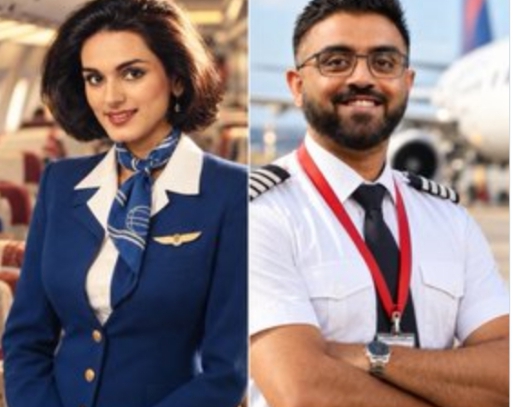
“Like Neerja, Captain Machchhar was seriously wounded trying to save others. Like Neerja, his quick thinking prevented the hijackers’ ultimate objective — to use the aircraft as a weapon and kill everyone on board”
By Ime Silas
Four decades apart, two Indian aviation professionals stared death in the face inside hijacked aircraft — and chose duty over self-preservation. Their stories, though separated by 40 years, bear striking similarities: extraordinary presence of mind under gunfire, sacrifice for passengers, and an unwavering commitment to the profession they swore to serve.
The first story began on 5 September 1986. Pan Am Flight 73 was flying from Mumbai, India to the United States, with a scheduled stop in Karachi, Pakistan. The Boeing 747 had 379 passengers and crew on board, a routine international service that would become one of the most harrowing hijackings in aviation history.
At Karachi airport, four armed hijackers dressed as airport security men stormed the aircraft and took control. In those chaotic first seconds, 22-year-old senior flight attendant, Neerja Bhanot did what would define her legacy. She warned the pilots in the cockpit through the intercom code, giving them time to escape through the overhead hatch as per standard hijack procedure.
With the pilots gone, Neerja became the most senior crew member left on board. For the next 17 hours, she was the de facto leader inside a pressure cooker.
Survivors and investigators would later reveal how she remained calm, served tea to the hijackers to keep them composed, comforted terrified passengers, and secretly hid the passports of American passengers — 41 Americans were on board — under seats and in trash chutes so the hijackers, who were demanding to identify Americans, could not single them out.
As night fell, power ran out and the hijackers panicked, opening fire indiscriminately and detonating explosives inside the cabin. Neerja had a clear chance to escape through the emergency exit. Instead, witnesses say she turned back.
She found three young children cowering near the exit and shielded them with her own body. She was shot repeatedly while protecting them. She died that day, but her actions saved more than 350 passengers. Only 20 people died in the massacre — a number that would have been far higher without her.
India later honoured her with the Ashoka Chakra, the country’s highest peacetime gallantry award. She became the youngest and first woman recipient. Her story was immortalised in the film Neerja, but for aviation professionals, she remains the gold standard of cabin crew bravery.
Forty years later, on 30 September 2026, history repeated itself — this time over the Middle East.
Captain Smit Machchhar, a veteran Indian pilot with 17 years of flying experience, was in command of flydubai flight FZ 1073 from Dubai to Tel Aviv. The flight had 174 people on board. Mid-air, his co-pilot allegedly turned on him inside the locked cockpit.
Israeli and Emirati investigators said the co-pilot stabbed Captain Machchhar and attempted to crash the aircraft, sending it into a terrifying dive of more than 17,000 feet in under two minutes.
Seriously injured, bleeding, and lying on the floor of the cockpit, Captain Machchhar could have given up. Instead, in a moment that echoes Neerja’s choice, he mustered his last strength to do the one thing that could save everyone: he opened the cockpit door.
That single action changed everything. It allowed the cabin crew to see the struggle and raise alarm. Israeli passenger Yaniv Hayun, who had no security training, rushed in, fought the attacker, immobilized him with a chokehold and dragged him out. The aircraft was levelled and a deadheading pilot on board took over and landed safely in Tel Aviv.
Like Neerja, Captain Machchhar was seriously wounded trying to save others. Like Neerja, his quick thinking prevented the hijackers’ ultimate objective — to use the aircraft as a weapon and kill everyone on board.
Two Indians. Two different decades. Two different roles — one in the cabin, one in the cockpit. But the same courage when people needed it the most.
The parallels are not just emotional, they are professional lessons. Aviation security experts point out that in both incidents, the Indian crew members violated the instinct for self-preservation and followed the highest tenet of aviation: the safety of passengers first.
In 1986, Neerja could have escaped early with the pilots. In 2026, Captain Machchhar could have remained incapacitated on the floor. Both chose to act.
Their stories also highlight a shift in how India is perceived in global aviation safety. From being celebrated for a flight attendant’s sacrifice in 1986 to being hailed today for a captain’s resilience, India has produced aviation heroes who have saved hundreds of foreign lives on foreign carriers.
As Prime Minister Benjamin Netanyahu told Captain Machchhar this week — “You are a hero for Israel, India, and the entire world” — it was a line that could have just as easily been said about Neerja Bhanot 40 years ago.
In an era where air travel is often taken for granted, the aborted hijacks of Pan Am 73 and flydubai FZ 1073 remind the world that behind the uniform are individuals whose courage at 35,000 feet still determines who lives and who dies.