
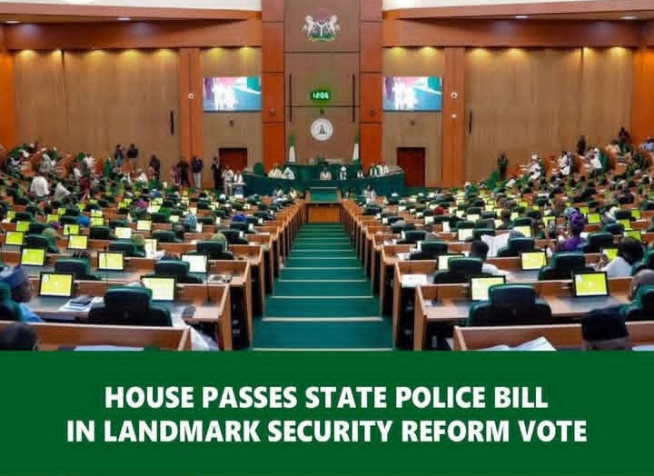
…paving way for decentralized policing
Ime Silas, Sanni Abdullahi
In what lawmakers described as a watershed moment for Nigeria’s security architecture, the House of Representatives on Thursday passed the Constitution Alteration Bill providing for the establishment of State Police and for Related Matters, clearing the first major legislative hurdle in a decades-long national debate.
The Bill was passed during plenary on Thursday, June 11, 2026, with an overwhelming 289 members voting in favour, 1 voting against, and none abstaining. The vote followed confirmation that 290 members were present, satisfying the constitutionally mandated two-thirds quorum of the 360-member House required for alterations to the 1999 Constitution.
The legislation, which contains 18 clauses, seeks to amend Sections 214–216 and other relevant provisions of the Constitution of the Federal Republic of Nigeria, 1999 as amended. After being read for the third time, it was put to a voice vote and subsequently a roll call, with the result reflecting near-unanimous cross-party support. As a key component of the ongoing constitutional review process, the Bill was prioritised for consideration and passage, while voting on other Constitution Alteration Bills was deferred to a later date.
A Shift Toward Decentralized Security
The decision represents what the House called a significant milestone in efforts to strengthen Nigeria’s internal security framework through a decentralised policing model. The Bill provides for the creation of State Police services across the 36 states of the federation and the Federal Capital Territory, while retaining the Nigeria Police Force as the national policing institution.
According to the provisions outlined in the press statement issued by the Office of the House Spokesman, the framework introduces clear mechanisms for coordination between federal and subnational policing authorities. It also embeds provisions for oversight, accountability, and the delineation of operational responsibilities to prevent jurisdictional conflicts and misuse of state security structures.
Proponents have long argued that a centralised policing system has struggled to respond effectively to localised threats ranging from banditry and kidnapping in the North West, to farmer-herder clashes in the Middle Belt, and separatist agitations in the South East. The new model is intended to deliver more responsive and effective security services by empowering states to recruit, train, and deploy personnel familiar with local terrain, languages, and community dynamics, while operating within national standards.
Leadership Hails “Decisive Constitutional Step”
Commenting on the outcome shortly after the vote, Speaker of the House of Representatives, Rt. Hon. Abbas Tajudeen, PhD, GCON, said security remains the bedrock of national development.
“By passing this Bill, the House has taken a decisive constitutional step towards creating a policing framework that is more responsive to local realities while remaining firmly anchored within the unity and sovereignty of the Federal Republic of Nigeria,” the Speaker stated. He noted that the near-unanimous vote reflected the urgency Nigerians attach to ending the cycle of violence that has undermined economic growth and social cohesion.
The Deputy Speaker of the House and Chairman of the House Committee on Constitution Review, Rt. Hon. Benjamin Okezie Kalu, described the result as a strong expression of the House’s responsiveness to national consensus.
“This outcome demonstrates that the 10th Assembly is listening to the yearnings of the Nigerian people,” Kalu said. “For years, governors, traditional rulers, civil society organisations, and security experts have called for reforms that bring policing closer to the people. Today, the House has answered that call through a structure that balances state autonomy with national unity.”
Kalu, who has led the constitutional review process since 2023, added that the Committee will continue public hearings and stakeholder engagements to refine implementation guidelines ahead of the Bill’s transmission to the Senate.
Part of Broader Constitutional Reform Agenda
The State Police proposal is not a standalone amendment. It forms part of a broader package of constitutional alterations currently under consideration by the National Assembly. Other areas covered in the ongoing review include electoral reforms aimed at improving the integrity of elections, judicial reforms to enhance speedy dispensation of justice, restructuring of local government administration, further devolution of powers from the federal centre to states, fiscal reforms, expansion of human rights protections, and institutional strengthening across government agencies.
The House of Representatives reiterated its commitment to an inclusive, transparent, and outcome-driven review process. According to the statement signed by Rep. Akin Rotimi, mnipr, Spokesman of the House, the objective is to deliver constitutional changes that strengthen democracy, enhance security, and improve governance delivery across the federation in line with the aspirations of Nigerians.
With passage by the House, the Bill now proceeds to the Senate for concurrence. Under Section 9(2) of the 1999 Constitution, any alteration must be approved by a four-fifths majority of the Senate and House of Representatives, and subsequently ratified by at least 24 of the 36 state Houses of Assembly before it becomes law.
Security analysts say the timeline for full implementation will depend on how quickly both chambers and the state assemblies act, as well as the capacity of states to meet the Bill’s standards for recruitment, training, funding, and oversight. Critics who have opposed state police in the past have raised concerns about possible politicisation, funding gaps, and human rights abuses at the subnational level. The accountability and coordination clauses in the new Bill are intended to address those fears.
For now, Thursday’s vote signals a major political breakthrough. After years of public debate, insecurity, and pressure from state governors, the lower chamber has taken the most concrete legislative step yet toward restructuring Nigeria’s policing system. Whether that translates into safer communities will depend on the details of implementation and the willingness of all levels of government to uphold the oversight provisions built into the law.
As Rep. Rotimi stated in the release, the House sees this as more than a security reform. It is, in their view, a test of Nigeria’s ability to adapt its 1999 Constitution to meet 21st-century realities without fracturing the unity of the federation.