

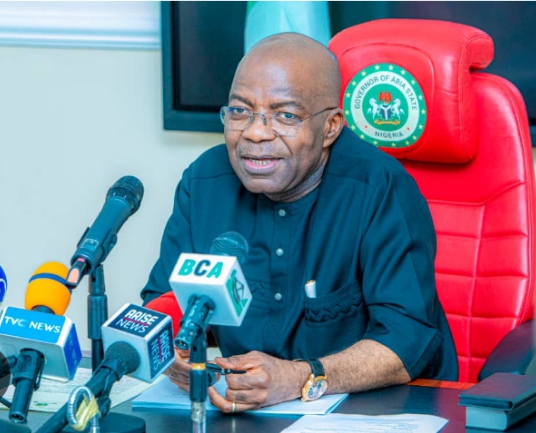
…signs new Education Reforms capping Certificate fee at ₦2,000
By Chucks Nwonye
In a bold and significant move to sanitize the education sector and reduce financial burden on parents, Abia State Governor, Dr. Alex Otti has approved major education reforms that will apply to both public and private schools across the state.
The reforms, which were announced by the Abia State Ministry of Education and the Government House, Umuahia, are aimed at stopping extortion of parents, curbing examination malpractice and restoring discipline and uniformity in the school system.
According to the government, quality education must be affordable, credible and focused on learning rather than what it described as ‘cash-outs’ by some school proprietors.
A statement from the Ministry of Education listed six key changes that every parent, school owner and student in Abia State must know.
The first major reform is the capping of First School Leaving Certificate, FSLC, fee. The government has directed that no school, whether public or private, should charge more than ₦2,000 for Primary 6 First School Leaving Certificate.
The measure, according to the government, is to stop the ugly trend where parents abandon their children’s certificates in schools due to high and arbitrary charges.
The second reform is the ban on transfer of students from SS2 to SS3. Under the new directive, students can no longer switch schools between SS2 and SS3. Wherever a student finishes SS2 is where he or she must write the West African Senior School Certificate Examination, WASSCE, and the National Examinations Council, NECO.
Government sources said the move is targeted at curbing examination malpractice, as some students were in the habit of moving to so-called special centres in their final year to cheat in external examinations.
Closely related to this is the third reform, which introduces a mandatory State Promotion Examination. To enter SS3, all SS2 students in Abia State, both in public and private schools, must pass a Government Centralized Promotion Examination.
The ministry said no student who fails the central promotion exam will be allowed to be registered for WAEC or NECO. The policy is expected to ensure that only students who are academically qualified are promoted to the final class.
The fourth reform, which has generated wide applause among parents, is the ban on lavish graduation ceremonies for Nursery and lower Primary classes.
Government said extravagant graduation parties for Nursery, Kindergarten and lower Primary classes are now banned in Abia State. Graduations are now allowed only for Primary 6 and SS3, which are considered transition classes.
The government said it observed that some schools compel parents to pay huge amounts for graduation clothes, hall rentals and parties for three and four-year-old pupils, thereby putting unnecessary financial pressure on families.
The fifth reform concerns the use of textbooks. The government has banned pupils and students from doing assignments inside textbooks. It said all assignments must be done in notebooks and not inside the textbooks themselves.
The directive is to make textbooks reusable, so that siblings can reuse books previously used by their older brothers and sisters, thereby saving parents from buying new textbooks every academic term and session.
The sixth pillar of the reform focuses on accountability and uniformity across the education system in the state.
According to the Ministry of Education, all the directives are aimed at reducing financial pressure on families, promoting a reading culture, and bringing uniformity and standard to the education system in Abia State.
Reacting to the reforms, many parents in Aba and Umuahia have commended Governor Otti for the initiative, describing it as people-oriented and timely, especially at a time when many families are struggling with rising cost of living.
Education stakeholders also noted that the ban on SS2 to SS3 transfer and the introduction of centralized promotion examination will go a long way in restoring credibility to public examinations and improving the overall performance of Abia students in external examinations.
The Abia State Government has warned that any school, public or private, that violates the new directives will face sanctions, including possible closure.
It urged parents to report any school that charges above ₦2,000 for FSLC, conducts lavish nursery graduation, or forces pupils to write assignments inside textbooks, to the Ministry of Education for appropriate action.
“The message is clear: Abia wants quality, not cash-outs,” the government stated.