

As Nigeria Expands Social Protection, Akwa Ibom Takes Humanitarian Support to the Doorsteps of the Poor
By Ekaette Okon Joseph
Nigeria’s social protection system received a major boost with the Federal Government’s disbursement of ₦4.2 billion to 56,402 vulnerable beneficiaries in Akwa Ibom State under the Renewed Conditional Cash Transfer Programme, reinforcing a national strategy that uses direct financial assistance to cushion the effects of inflation, rising food prices and declining household incomes.
While the Federal Government’s intervention delivers cash directly to vulnerable citizens via preloaded debit cards, Akwa Ibom State has developed a complementary model that extends humanitarian assistance beyond financial support. Through Governor Umo Eno’s ARISE Agenda, the Ministry of Humanitarian Affairs has institutionalised the ARISE Share and Care Programme.
This community-based food intervention delivers food items directly to vulnerable households in their villages across all 31 local government areas.
Rather than requiring elderly persons, widows, persons with disabilities and indigent families to travel to urban centres to access government support, officials move the intervention to the beneficiaries themselves, ensuring that those least able to travel are not excluded from assistance.
The approach reflects a growing recognition that effective social protection extends beyond policy announcements and budgetary allocations to the practical question of whether assistance reaches those who need it most.
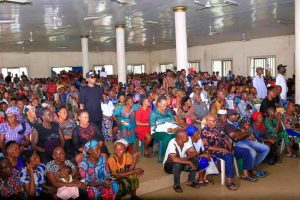
Speaking during the distribution of Federal Government debit cards in Ika Local Government Area, the Commissioner for Humanitarian Affairs, Princess Emem Ibanga, described the Conditional Cash Transfer Programme as a significant intervention that would improve livelihoods at the grassroots.
“Humanity is the focus of this administration, and we deeply appreciate President Bola Ahmed Tinubu for creating this direct medium to reach our people at the grassroots,” she said.
Ibanga disclosed that under the current phase of the programme, 56,402 beneficiaries captured in the National Social Register across Akwa Ibom’s 31 local government areas are receiving preloaded debit cards valued at ₦75,000 each, representing ₦25,000 monthly for three months.
“Whether it serves as start-up capital or support for an existing small business, this intervention will go a long way in transforming lives in our communities,” she said.
She noted that the Federal Government’s programme aligns with Governor Umo Eno’s broader humanitarian vision under the ARISE Agenda.
According to the Commissioner, the state has already reached more than 650,000 households through its food security and palliative interventions, making social welfare one of the central pillars of the administration’s governance strategy.
“His Excellency, Governor Umo Eno, has provided a conducive environment for these Federal Government programmes to thrive alongside our state initiatives,” she said.
“Even as the Federal Government team continues its distribution across the local government areas, another round of state-sponsored palliative distribution will commence immediately.”
That state intervention is driven largely through the ARISE Share and Care Programme, where food is taken directly to communities rather than expecting vulnerable citizens to travel long distances in search of government assistance.
Across the state’s rural communities, distribution teams move from village to village, working through ward structures and community leaders to identify beneficiaries and deliver food items directly to them.
For many elderly residents living in remote communities, the programme removes one of the biggest barriers to accessing government support, namely transportation.
Instead of spending scarce resources travelling to collection centres, beneficiaries receive assistance within their own communities.
The model particularly benefits older persons who are physically unable to undertake long journeys, widows without stable income, persons living with disabilities and other vulnerable households whose economic realities often make transportation costs an additional burden.
Beyond providing immediate relief, the programme also strengthens community participation by allowing local leaders and ward officials to coordinate distribution within their respective areas.
Ibanga said the humanitarian philosophy behind the programme was simple: government support should be accessible to those who need it most.
She further announced that the state government is preparing another major intervention targeted at women’s cooperatives across the 31 local government areas.
According to her, the initiative forms part of Governor Umo Eno’s commitment to women’s economic empowerment, poverty reduction and grassroots development.
The planned support is expected to strengthen cooperative societies, improve access to capital and expand income-generating opportunities for women across rural communities.
By combining the Federal Government’s Conditional Cash Transfer Programme with the state’s food intervention and the forthcoming cooperative support initiative, Akwa Ibom is gradually building an integrated social protection framework that addresses both immediate welfare needs and longer-term economic resilience.
Earlier, Chairman of Ika Local Government Council, Barrister Utibe Nwoko, commended President Bola Ahmed Tinubu for extending the Conditional Cash Transfer Programme to 1,682 beneficiaries within the local government area.
He urged beneficiaries to maintain order during the distribution process to ensure transparency and accountability.
Nwoko also appreciated Governor Umo Eno for providing the peaceful environment that has enabled both Federal and State humanitarian programmes to operate successfully across Akwa Ibom.
Officials who witnessed the exercise included the State Programme Manager of the Conditional Cash Transfer Programme, Mr Innocent Okure, Local Government Coordinator, Mr Ubong Ned, and officials of the Ministry of Humanitarian Affairs.
Akwa Ibom’s experience illustrates how federal and state interventions can complement one another when coordinated through structured institutions. While Abuja provides direct financial support through nationally funded programmes, the state government extends assistance through community-based humanitarian initiatives that reach people where they live.
The Ministry of Humanitarian Affairs has become the coordinating institution linking these interventions under the ARISE Agenda.
Its responsibilities now extend beyond emergency relief to include food security, disability inclusion, humanitarian partnerships, community welfare and poverty reduction programmes designed to improve the quality of life of vulnerable citizens.
The result is a governance model in which social protection is no longer measured solely by the amount of money allocated, but by how effectively assistance reaches the people for whom it is intended.
For thousands of elderly residents, widows and low-income families across Akwa Ibom, that assistance is increasingly arriving not at distant government offices or crowded urban centres, but at the entrances of their villages, where public policy meets everyday life and where the promise of compassionate governance is translated into tangible support for those most in need.