
By Our Correspondent
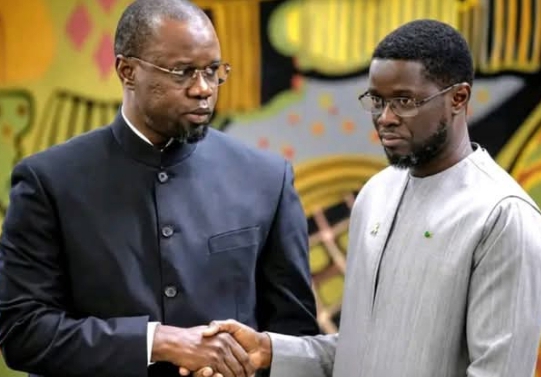
President Bassirou Diomaye Faye has formally broken with the party that brought him to power, announcing the launch of his own independent political organisation and marking the official end of his alliance with Prime Minister Ousmane Sonko.
The announcement came late Tuesday during a four-hour strategy meeting at the Presidential Palace in Dakar attended by 306 regional mayors representing the Coalition Diomaye Président. In remarks to the gathering, Faye said the new movement would be built to “carry forward the reform agenda without the constraints of party structures.”
With that decision, two men who rose to power together less than two years ago are now building separate political machines.
Faye and Sonko entered office in 2024 on a wave of popular frustration with Senegal’s old political class. Their campaign was fueled by mass protests in which young people took to the streets and several people were killed. Both men spent time in detention before the presidential election. The central promise was reform, accountability, and a decisive break from the corruption associated with the Macky Sall era.
That partnership helped deliver a historic victory for PASTEF, the African Patriots of Senegal for Work, Ethics and Fraternity. But the coalition has fractured rapidly once in government.
Sonko now controls the National Assembly as Speaker and retains a powerful grassroots base, particularly among youth. Faye controls the presidency and the executive machinery of the state. Both command significant followings and, according to people close to the palace, both have developed legitimate grievances against the other over strategy, appointments, and the direction of policy.
The split was not unexpected in Dakar political circles, but making it formal changes the calculations for the next three years.
“This is not unique to Senegal,” a senior political analyst in Dakar said. “Across Africa you see the pattern. Revolutionary rhetoric unites people against a common enemy. You win. Then personal ambition, competing visions, and the realities of governing begin pulling in different directions. The voter who believed in the movement discovers the movement was also about the men leading it.”
For Senegalese citizens, the immediate question is whether the separation produces better governance or simply more organized competition for power.
There have been some institutional gains during the current term that appear unaffected for now. The National Assembly recently passed constitutional amendments limiting presidential authority, a move widely seen as strengthening checks and balances. Faye’s departure from PASTEF does not automatically reverse that.
But the political cost could be high. Government officials and civil society leaders note that energy spent on internal positioning is energy not spent on the urgent problems that brought Faye and Sonko to power. Electricity costs remain a burden for households and businesses. Youth unemployment continues to drive migration. And the management of newly flowing oil and gas revenues will define Senegal’s economic future for the next decade.
Those issues require coordination between the presidency and the legislature, precisely the relationship now under strain.
Eminent Senegalese voices, including religious leaders and former ministers, have begun calling for dialogue between the two camps. They argue the country cannot afford for its two most prominent reform figures to spend the next three years fighting each other while structural challenges pile up.
The new organisation launched by Faye will be built around the Coalition Diomaye Président, the network of mayors and local officials who mobilized for him in the election. It is intended to operate independently of PASTEF’s party structure, giving the president his own base in parliament and in the regions ahead of upcoming local and legislative contests.
Sonko, for his part, retains control of PASTEF’s machinery and the speaker’s office, which gives him agenda-setting power in the National Assembly.
What happens next will depend on whether both leaders choose competition or cooperation. Senegal’s democracy has shown resilience through multiple transitions, but the current moment tests whether reform can survive the politics of power.
For now, the alliance that promised to break with the past has itself broken. Voters who marched, protested, and voted for change will be watching closely to see what is built in its place.